Has the ECB reached the end of its tightening cycle?
At the beginning of the year, the European Central Bank (ECB) appeared set to keep interest rates unchanged throughout 2026. After a successful disinflation process, inflation had...
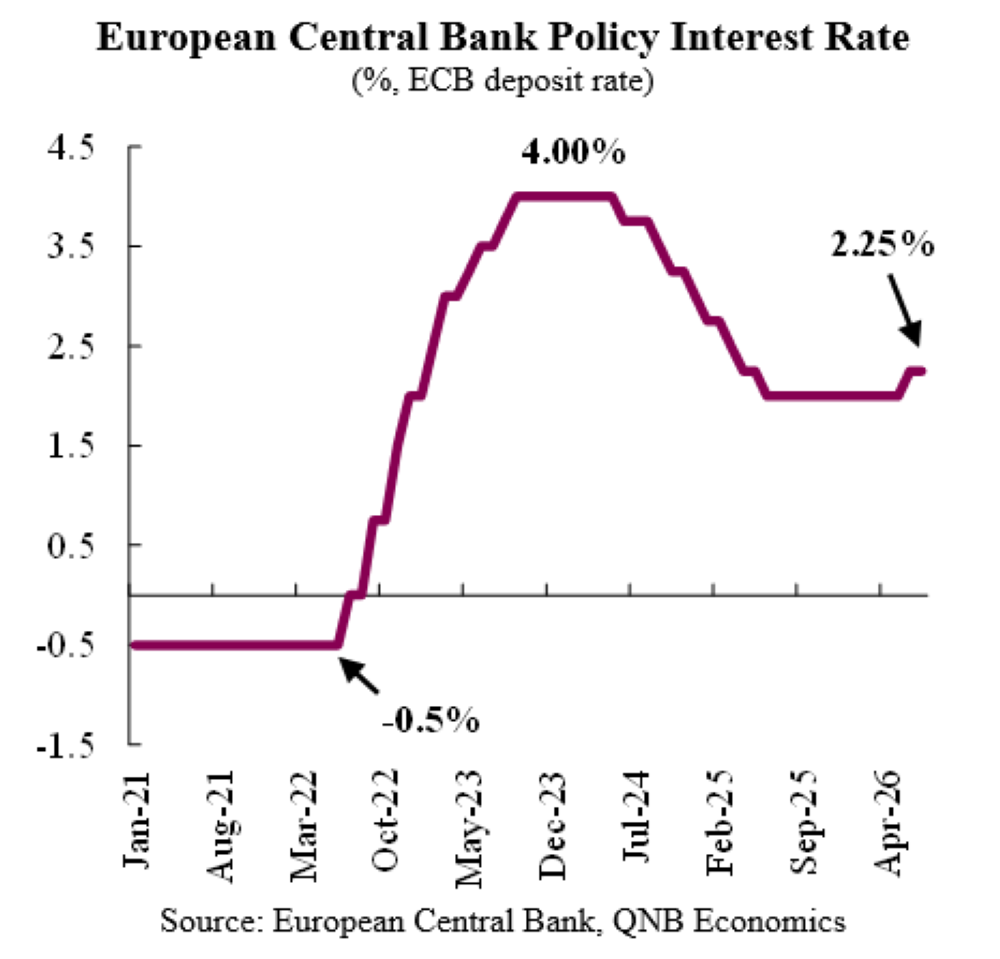
By early 2026, the European Central Bank (ECB) seemed poised to maintain interest rates without adjustment through the year. A successful reduction in inflation had brought it close to the ECB’s 2% objective, with the deposit rate at 2%, a figure generally viewed as neutral. However, the emergence of the US-Iran conflict altered this perspective.
The conflict led to supply disruptions and bottlenecks in shipping through the Strait of Hormuz, causing a rapid increase in oil and natural gas prices. This surge pushed inflation above the target, prompting policymakers to become increasingly worried about the potential for higher energy costs to permeate other goods and services, thereby prolonging inflation through second-round effects.
The Euro Area is particularly vulnerable to natural gas price fluctuations, as it not only forms a substantial portion of energy imports but also serves as a critical price determinant in electricity markets. In response, the ECB increased its deposit rate by 25 basis points in June to curb what was initially seen as a short-lived energy shock from turning into a broader inflation issue.
However, these consequences have thus far been managed by monetary policy, barring a more sustained and significant jump in energy prices. This article examines three principal elements that bolster this conclusion.
Firstly, the inflation concerns that triggered the June rate hike have eased. Despite the ongoing US-Iran conflict, recent inflation data indicate that higher energy costs are not significantly affecting the broader economy. Both headline and core inflation figures came in below expectations in June, while wage growth has been gradually decelerating, limiting the risk of second-round effects.
Furthermore, euro inflation swap rates—reflecting market expectations of inflation over the next year—have slipped below the ECB’s 2% benchmark. Collectively, these developments imply that the inflation shock is likely temporary, diminishing the rationale for further rate hikes.
Secondly, the outlook for economic growth in the Euro Area has weakened, supporting the case for no additional increases in policy rates. Business activity has been sluggish, with the composite Purchasing Managers’ Index (PMI), which integrates manufacturing and services, remaining below the 50-point mark that distinguishes expansion from contraction for the past three months.
This slowdown has led analysts to adjust their growth forecasts, with consensus estimates for real GDP growth this year falling from 1.2% prior to the US-Iran conflict to 0.6%. Diminished economic growth is also expected to reduce underlying inflationary pressures by tempering demand across the economy. Consequently, further monetary tightening could unnecessarily burden an already fragile economy.
Thirdly, recent statements from the ECB suggest that policymakers are growing more at ease with maintaining interest rates steady. At the June meeting, the Governing Council underscored its commitment to a data-driven, meeting-by-meeting policy stance, without pre-determining a specific trajectory for policy rates. This message was reinforced at the ECB’s annual Forum on Central Banking in Sintra, Portugal, where central bankers, scholars, and financial market participants convene annually to discuss global economic trends and monetary policy challenges.
President Lagarde highlighted that risks to inflation and growth had become more evenly distributed. Other members of the Governing Council also hinted at a wait-and-see approach, with some expressing openness to preserving policy rates unchanged if forthcoming data continue to demonstrate that inflation risks are diminishing. Combined, these recent remarks indicate that the Governing Council is increasingly concentrating on evaluating incoming data rather than preparing for another near-term interest rate increase.
Overall, the ECB’s June rate hike was a fitting reaction to the temporary inflation risks. Nonetheless, sustained advancements in the disinflation process, a more subdued growth outlook, and recent ECB communication collectively suggest a reduced necessity for additional rate hikes. Unless a new inflationary shock arises or persistent price pressures emerge, the June increase is likely to signify the conclusion of the ECB’s tightening cycle, with policy rates anticipated to remain unchanged throughout the rest of the year.
Written by urgent.news from Qatar Tribune Business's reporting — not their text. Machine-written — may contain errors; check the original before relying on it.