Revelando como os caranguejos conseguem escapar
Os Neohelice granulata , verdadeiros Houdinis, oferecem uma rara oportunidade de realizar registros intracelulares em animais acordados e em movimento.
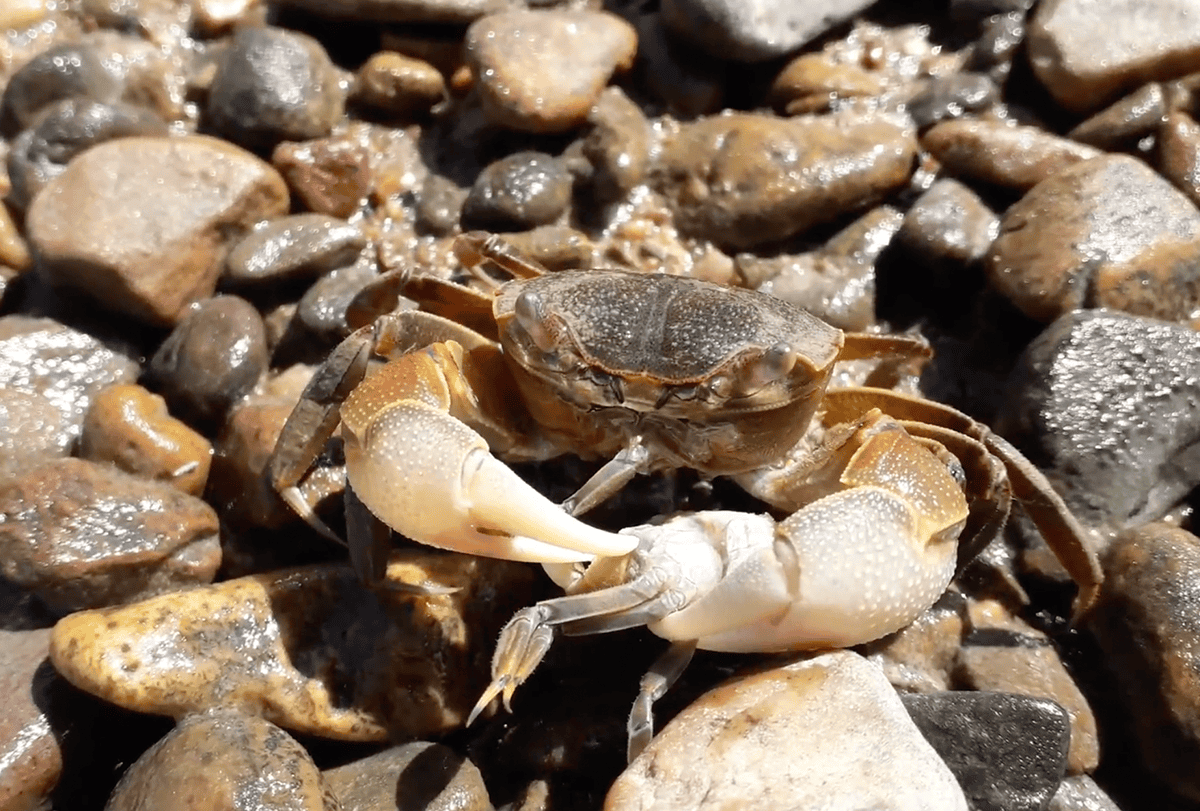
The Neohelice granulata, remarkable escape artists, provide a unique opportunity to conduct intracellular recordings in awake and moving animals. Along Argentina's Atlantic coast, numerous crabs excavate burrows in the sandy estuaries and pans. Professor Daniel Tomsic from the University of Buenos Aires has observed these common creatures, Neohelice granulata, entering and exiting their burrows rapidly every time he visits the beach.
Tomsic now studies how the crabs' ganglia control their escape behavior guided by vision in these same animals. Seagulls hunt these creatures, which are only slightly larger than a guitar pick. When a crab sees a seagull flying above it, it must decide whether to flee and in which direction. This is the same calculation a tennis player must make when assessing a 200 km/h serve and deciding when to return the shot, according to Tomsic.
"Nobody knows how these time-to-collision calculations are made," he says, adding that the crab is an adequate model organism to study this question. Tomsic inherited the model from his mentor, Hector Maldonado, who introduced the Neohelice as a neuroethological model in Argentina after returning from 18 years of exile. Tomsic advanced the work by performing intracellular recordings in live moving animals, something that had only been done in insects and only after removing the animal's arms and legs.
The rigid exoskeleton of the crab and the accessible brain region, which can be reached through a small hole drilled in the cuticle, made this possible, says Tomsic. Intracellular recordings revealed the circuits connecting visual stimulation to motor response. The decision to flee is triggered as soon as the approaching object's apparent size reaches a certain threshold, according to Tomsic's work with his colleagues.
The crab continuously adjusts its running speed as the threat expands, immediately slowing down if the stimulus stops growing. A single giant neuron, MLG2, codes the speed at which the threat expands and controls this speed adjustment in real-time, while another neuron, MLG1, controls the crab's immobilization response. Field studies in collaboration with Jan Hemmi, a professor of biological sciences at the University of Western Australia, revealed that crabs behave differently in the lab and in nature.
In the lab, crabs consistently flee in the opposite direction to the approaching stimulus and wait until the object appearing to be large enough before moving. In the field, however, crabs flee in response to smaller stimuli and run to their burrows to hide, even if the burrow is in the same direction as a predator. Without a hiding place, lab animals remain motionless to avoid detection.
"That was a big lesson for me," says Tomsic. This difference showed that laboratory conclusions about natural behavior pose a real risk without field checks, Tomsic says. More recently, Tomsic has focused on the decision-making behind crabs' escape behavior and how the presence of other crabs affects when and how each crab decides to flee. Since Neohelice prey on each other, this model also allows researchers to study predatory behavior.
Written by urgent.news from The Transmitter's reporting — not their text. Machine-written — may contain errors; check the original before relying on it.