Nancy Grace Roman Space Telescope launches Sunday!
The launch of the Nancy Grace Roman Space Telescope is scheduled for launch Sunday morning, August 30, from the Kennedy Space Center. More here. The post Nancy Grace Roman Space Telescope launches Sunday! first appeared on EarthSky .
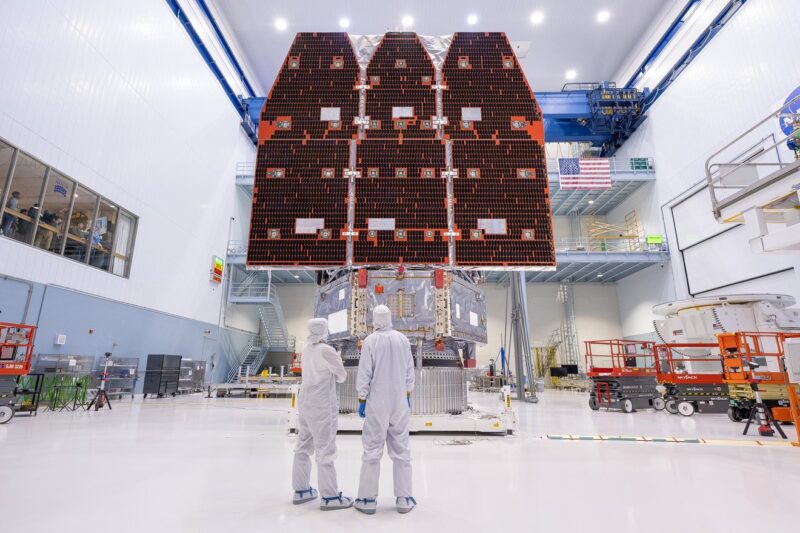
On August 30, NASA plans to launch its latest ambitious space telescope, the Nancy Grace Roman Space Telescope. The spacecraft will be carried aloft by a SpaceX Falcon Heavy rocket from Kennedy Space Center and will journey to its new home approximately 1 million miles from Earth at the L2 Lagrange point.
This powerful telescope boasts a primary mirror measuring 7.9 feet (2.4 meters) in diameter, which is similar in size to the Hubble Space Telescope. However, the Nancy Grace Roman Space Telescope has a 100 times larger field of view than Hubble’s infrared instrument, allowing it to scan the sky much more rapidly and thoroughly.
The Wide Field Instrument (WFI), the telescope’s primary tool, will capture images of billions of galaxies, thousands of new exoplanets, hundreds of black holes, and vast volumes of data for astronomers to study. By contrast, the James Webb Space Telescope, which also orbits at L2, features a smaller field of view and is better suited for observing individual distant objects in great detail.
One of the key objectives of the Nancy Grace Roman Space Telescope is to locate exoplanets, planets orbiting distant stars. Scientists expect the telescope to discover approximately 100,000 exoplanets within five years, significantly increasing the current count of over 5,000. The telescope’s Coronagraph Instrument, a high-contrast imaging tool, will enable the direct imaging and spectroscopy of these distant worlds, providing valuable insights into their composition, atmosphere, and potential habitability.
Beyond exoplanet detection, the Roman Space Telescope will also study the cosmic dawn, the period of our universe's history when the first stars and galaxies began to form. By observing the early stages of cosmic structure formation, astronomers hope to gain a deeper understanding of the evolution of our universe.
Written by urgent.news from EarthSky's reporting — not their text. Machine-written — may contain errors; check the original before relying on it.