Earthquake fault irregularities control rupture speed and influence ground motion
New models show that high-speed rupture propagation produces stronger and longer-duration ground motion The post Earthquake fault irregularities control rupture speed and influence ground motion appeared first on Physics World .
Earthquakes that travel faster cause more intense shaking than those that move more slowly, according to researchers at the California Institute of Technology. Mohamed Abdelmeguid and his team demonstrated through physics-based models that "supershear" ruptures generate stronger and longer-lasting ground motion compared to equivalent "subshear" ruptures.
However, current models used to set infrastructure standards do not account for this effect, which could lead to an inaccurate assessment of hazards like the 2025 Myanmar earthquake, which exhibited supershear rupture in multiple directions.
Earthquakes are classified into two categories based on their rupture speed: supershear and subshear. Shear waves, or S waves, travel at specific velocities depending on the stiffness and density of the ground. When a rupture exceeds the shear-wave velocity of the surrounding ground, it is classified as supershear. Otherwise, it is considered subshear.
Although supershear rupture was theoretically predicted in the 1970s and observed in both laboratory experiments and real-world events, most previous research focused on understanding their mechanisms and the transition from subshear to supershear. Abdelmeguid's new study, published in the Bulletin of the Seismological Society of America, expands on this by comparing the ground motion of supershear earthquakes to subshear ones.
To address this gap, Abdelmeguid and his colleagues developed a dynamic rupture model that generates simulated ground motion data. Their findings reveal that prolonged supershear propagation results in a distinct spatial pattern of stronger and longer-duration shaking. However, episodic supershear segments—where rupture speed alternates between supershear and subshear—produce ground motion similar to subshear ruptures.
These simulations are crucial as some supershear rupture scenarios are poorly represented in the observational record, which is essential for developing accurate ground motion models used to assess earthquake hazards.
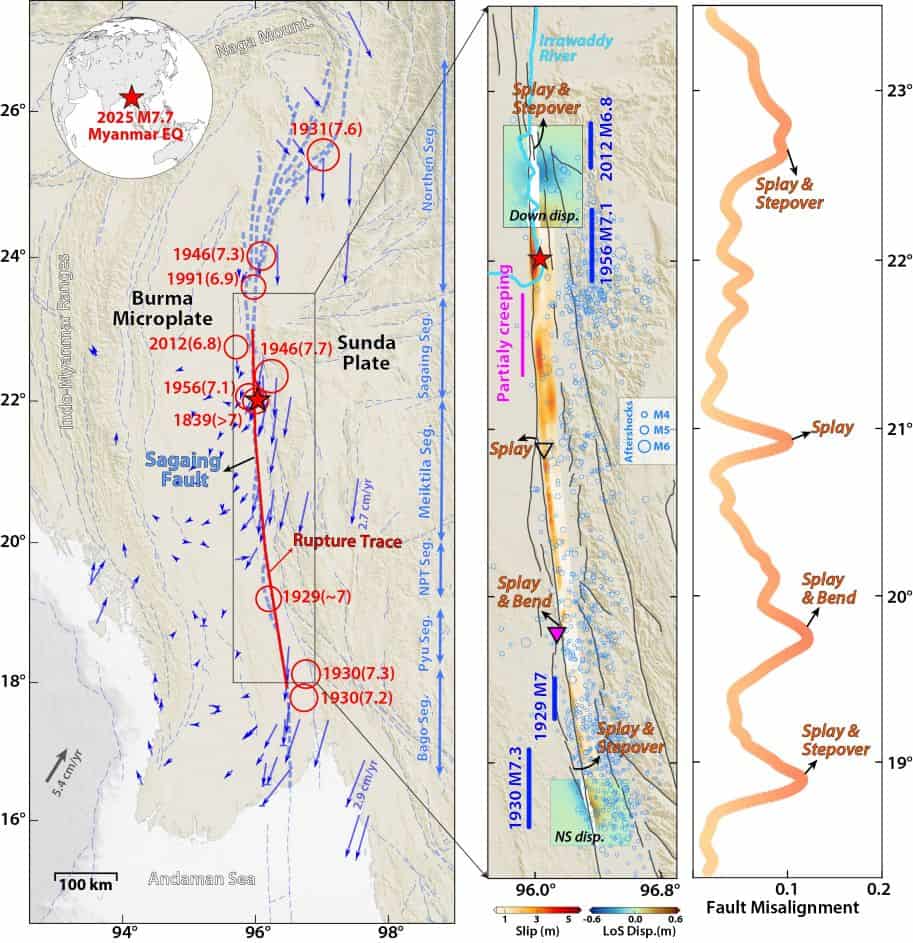
The 2025 Myanmar earthquake, a supershear event with a magnitude of 7.7 and the largest in Myanmar in over a century, serves as a case in point. The 1200-kilometre-long Sagaing Fault, which marks the boundary between the Burma and Sunda plates near Mandalay, experienced the longest rupture, causing high ground shaking in large parts of Myanmar and Thailand.
While initial studies were inconclusive about whether the rupture was intermittent or sustained, recent satellite earth observations, teleseismic data, and CCTV footage combined with near-fault seismic sensor data allowed researchers led by Lingling Ye at China’s Southern University of Science and Technology to model the rupture process and reveal new dynamic rupture features.
The researchers found that supershear speeds coincided with fault stretches that had lower misalignment, indicating irregularities in the fault geometry. Higher fault misalignment, such as bends and branches, was associated with subshear speeds, suggesting that the rupture decelerates at locations with high fault misalignment. Additionally, the rupture speed depended on local stress levels, with higher stress inducing faster rupture speeds.
The 2025 Myanmar earthquake was unique in that supershear rupture propagated away from the epicentre on both sides, traveling 80 kilometres to the north and 380 kilometres to the south. This finding underscores the importance of considering supershear effects in earthquake models to accurately assess seismic risks.
Written by urgent.news from Physics World's reporting — not their text. Machine-written — may contain errors; check the original before relying on it.