Almost every SA home now has a cellphone
But 740,000 homes still have no phone
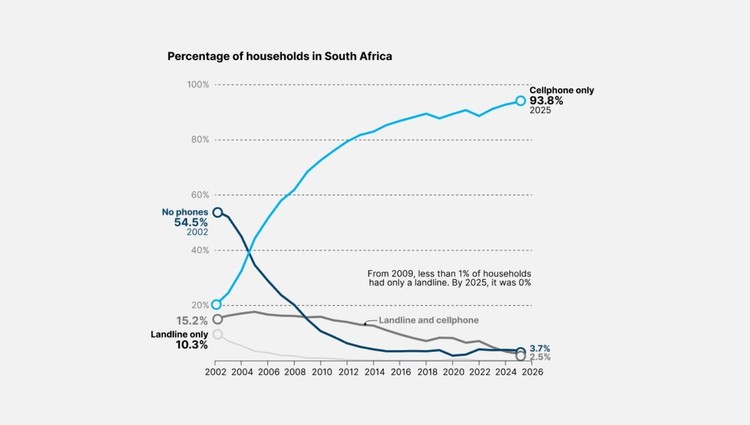
In 2002, nearly half of South African households lacked telephones, a figure that plummeted to just over 3.7% by 2025, equating to roughly 740,000 homes. Mobile phone usage surged dramatically during this period, with only 20% of households owning a mobile device in 2002, and this number expanding to 93.8% of homes in 2025. Moreover, the ratio of households possessing both a mobile and landline decreased significantly, from 15.2% in 2002 to 2.5% in 2025, as no households were found to have solely landlines.
While the data from Stats SA does not distinguish between basic cellphones with SMS or voice capabilities and smartphones capable of internet connectivity, ICASA's separate 2019 report revealed that 91% of South Africans owned smartphones. The proliferation of cellphones has facilitated access to information, government services, job-seeking platforms, mobile banking, and money transfers for the unbanked, along with boosting informal trade through e-wallets and Bluetooth or SIM-connected card machines.
However, the rise in mobile technology is not without its drawbacks; it has led to an increase in online gambling (R1.1-trillion was wagered by South Africans in 2024), scams, cybercrime, and the adverse effects of social media.
This revolution in connectivity for South Africa began in the 1990s and early 2000s when Telkom, a monopoly on telephone technology, was mandated to extend telephone lines to previously underserved regions during the apartheid era. Despite the construction of millions of new lines, many were subsequently disconnected due to unaffordable subscriptions.
The decline in fixed telephone lines was further accelerated by copper cable theft and the emergence of more affordable, prepaid mobile services. Telkom discontinued its prepaid copper-based telephone services in 2019 and transitioned its landline customers to wireless and fiber services. Fixed phones operating on wireless or fiber are still labeled as "landlines."
The complete phase-out of Telkom's post-paid copper telephone service is ongoing, with only 609,000 clients utilizing copper lines for voice and broadband by 2024, a stark contrast to over 5-million at the turn of the century. Yet, substantial work remains to be done. Mobile data costs are still prohibitively high, and cellphone connectivity remains inconsistent in many areas, with 3.7% of households, approximately 740,000, still lacking phone connectivity.
This significant number of unconnected households faces challenges in accessing government services, including the R370 SRD grant for unemployed individuals.
Written by urgent.news from GroundUp's reporting — not their text. Machine-written — may contain errors; check the original before relying on it.