Why Was This 17th-Century Polish Woman Buried With a Padlock on Her Toe and an Iron Sickle Across Her Neck?
New research suggests that the people who buried the young woman took precautionary measures to stop her from coming back to life and exacting revenge on them
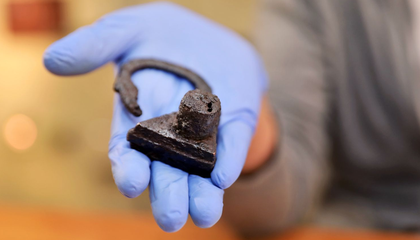
In the mid-17th century, a young woman named Zosia was buried in Pień, Poland, after dying under mysterious circumstances. Over 300 years later, archaeologists discovered her grave to be unusually filled with iron objects: a sickle laid across her throat, with the blade facing towards her, and a triangular padlock attached to her big toe.
Researchers led by Dariusz Poliński from Poland’s Nicolaus Copernicus University have been investigating the significance of these items and published their findings in the Journal of Archaeological Science: Reports.
The team suggests that the locals viewed Zosia as a threat, blaming her for misfortunes such as disease and famine without clear reasons. To prevent her from rising from the dead and causing further harm, they initially placed a lock around her toe and later added the sickle over her neck. Copper, manganese, and gold traces were found on Zosia's palate, possibly indicating another object was inserted in her nose or mouth, but this remains unidentified.
The grave, labeled Grave 75, was not the only peculiar burial in the Pień cemetery. Archaeologists have also unearthed a child buried facedown with a padlock under their foot and skeletons weighed down with rocks.
These atypical burials, sometimes referred to as "anti-vampiric," likely stem from the belief that the woman was a demonic being or outsider due to her social status or tragic circumstances. The cemetery is speculated to be located on unconsecrated ground, away from churches or chapels, used to bury the poor and disgraced. Zosia herself was likely an elite member of society, given the silk fabric with gold threads discovered on her skull, suggesting she wore an expensive cap trimming.
The cause of her death and her origins remain unresolved, but the researchers are still studying her remains and other unusual burials in the Pień cemetery to better understand her life and the context of their placement.
Written by urgent.news from Smithsonian's reporting — not their text. Machine-written — may contain errors; check the original before relying on it.