What experts know so far about Nepal’s deadly floods
Videos showed a wall of mud engulfing buildings and tossing vehicles aside as flash floods and landslides swept away entire villages, killing at least 165 people.
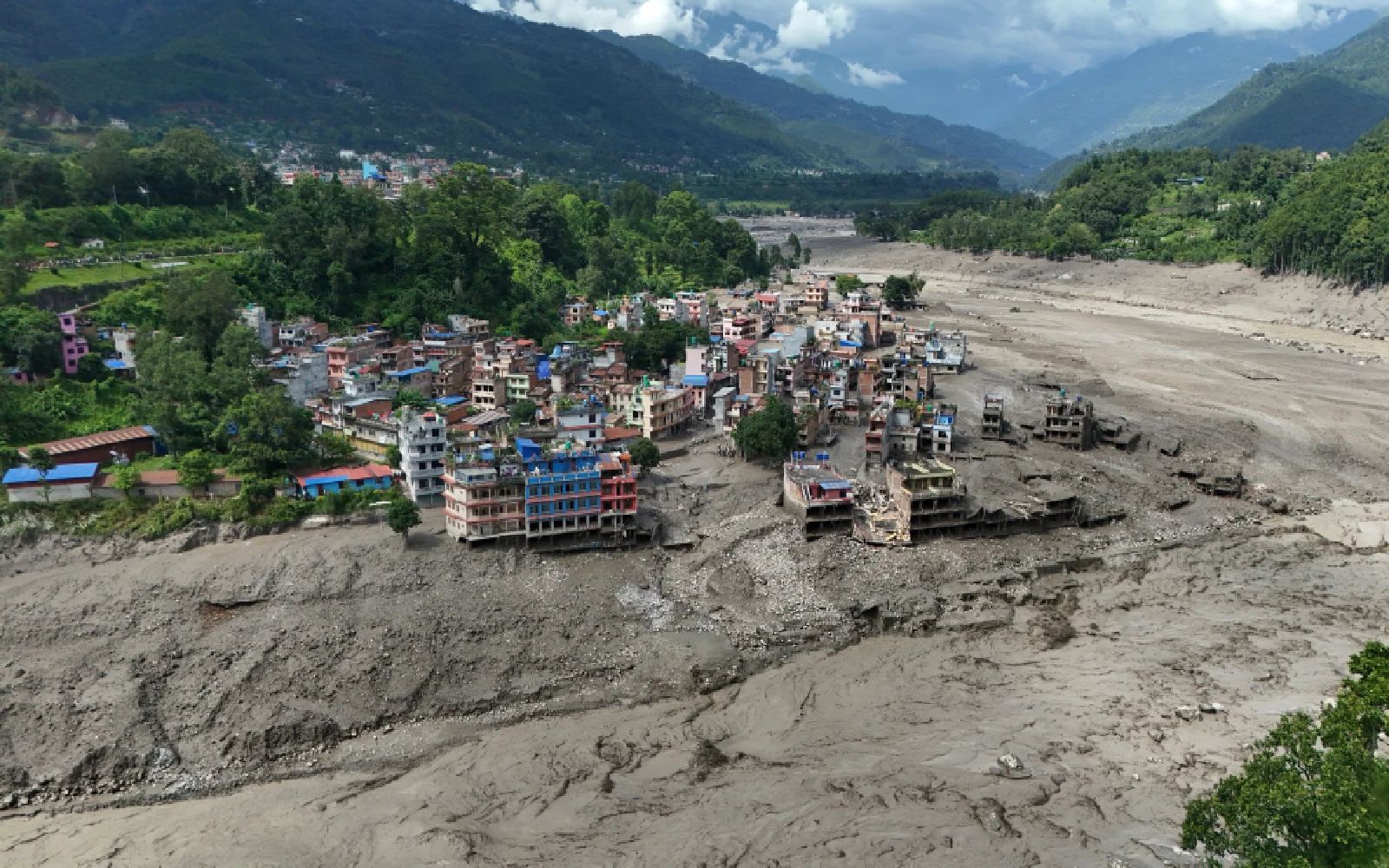
Washington: The origin of the recent deadly landslide and flood along the Nepal-Tibet border remains uncertain, yet experts emphasize how the region's severe terrain and climate change exacerbate risks. Among these hazards are glacial lake outburst floods (GLOF) -- the sudden release of massive amounts of water from melting lakes fed by glaciers.
The flash floods and landslides claimed over 165 lives, demolishing villages. Aerial footage revealed a wall of mud demolishing buildings and sending vehicles flying like toys. Initially, Nepal's Foreign Minister Shishir Khanal speculated an earthquake might have triggered the landslide, which then obstructed a river and released water downstream.
However, a revised report by the US Geological Survey stated that seismic energy was produced by a glacial collapse and debris flow, not an earthquake.
Dorothy Heinrich, a researcher at the University of Reading, explained to AFP that GLOFs are among the hazards posed by a warming planet in the Himalayas, with high confidence of more heat waves, glacial retreat, and permafrost reduction. Yet, determining whether a specific event is linked to climate change involves attribution studies, comparing the likelihood of the event in today's climate to the pre-industrial era using simulations.
A glacial outburst flood occurred in July 2025 in China's Gyirong County, then traveled into Nepal's Rasuwa District. An ICIMOD preliminary assessment found no anomalies on the Chinese side of the border, suggesting a rock-ice avalanche in Nepal blocked the Lhende river, leading to the cascading flood event.
University of Texas hydrologist Hatim Sharif noted the absence of rainfall before the disaster, rendering traditional flood warning systems ineffective. He emphasized that attempting to escape by running or vehicle is futile, as the mud and water moving at high speed create a lethal combination. The only viable solution, according to Sharif, is to ascend a hill, ideally at least 20 feet above the flood line.
To mitigate future risks, implementing real-time river level gauges that alert authorities could provide residents with valuable 20-30 minutes of warning, warned Qianggong Zhang, head of climate and environmental risks at ICIMOD.
Written by urgent.news from Free Malaysia Today's reporting — not their text. Machine-written — may contain errors; check the original before relying on it.
This story
This is one outlet's version. Read the fullest account.
- What experts know so far about Nepal's deadly floods gulfnews.com
- 160 dead, 647 missing as floods devastate Nepal, Tibet punchng.com
- What experts know so far about Nepal's deadly floods phys.org
- What experts know so far about Nepal’s deadly floods freemalaysiatoday.com
- Nepal floods: 55 Malaysians uncontactable, no casualties confirmed nst.com.my
- Mumbai-based mountaineer goes missing in Nepal flash floods hindustantimes.com
- What triggered Nepal’s catastrophic flash floods? USGS rules out earthquake timesofindia.indiatimes.com
- ‘Just a day ago, we were there’: Mumbai actor on narrow escape from Nepal floods indianexpress.com