Theory-Defying Exoplanet Atmospheres Force a Rethink of Theories
The discovery of lava worlds with atmospheres is challenging our theories of how atmospheres escape, and calling into question the idea of the cosmic shoreline. Stanford researchers have developed a model that explains how lava-covered worlds close to their stars can retain their atmospheres. The new theory could inform the search for life beyond our Solar System.
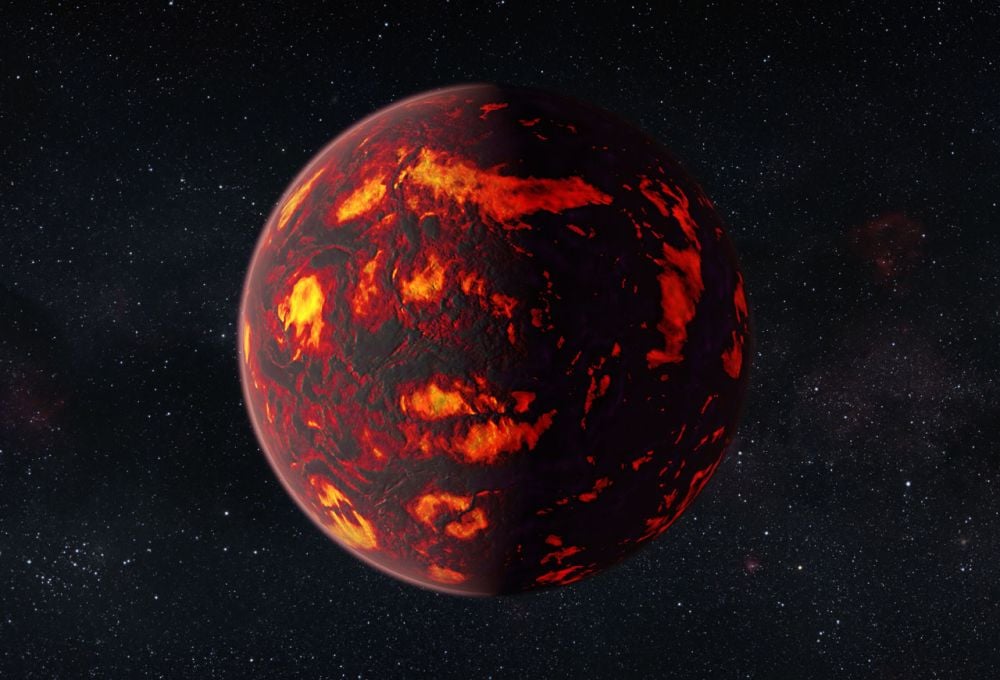
A groundbreaking study has challenged the long-held concept of the "cosmic shoreline," a boundary between planets and moons retaining atmospheres and those that do not. The study, titled "An Evolving Cosmic Shoreline and Sandbar Bounding the Rocky Airless Valley," was published in The Astrophysical Journal Letters and co-authored by graduate student Barron Nguyen from the Stanford Doerr School of Sustainability.
The researchers, utilizing data from the James Webb Space Telescope (JWST), have unveiled two previously unknown escape boundaries that replace the traditional cosmic shoreline, giving rise to three distinct regimes for atmospheric loss and retention on rocky planets near stars. These regimes are the cosmic sandbar, cosmic shoreline, and the previously unrecognized airless valley.
The cosmic sandbar regime is populated by magma oceans and lava worlds, such as 55 Cancri e, where outgassing helps maintain an atmosphere. Conversely, the airless valley regime includes planets like Mercury and TRAPPIST-1b, which experience atmospheric escape faster than it can be replenished. The cosmic shoreline regime straddles the border between the two, comprised of planets capable of retaining an atmosphere through continuous replenishment, like Earth and Venus.
These findings have critical implications for the search for potentially habitable worlds. The new model offers a more nuanced understanding of the factors determining where the cosmic shoreline lies for specific stars and planets, thereby providing a more accurate framework for identifying exoplanets with the potential to harbor liquid water and life.
Written by urgent.news from Universe Today's reporting — not their text. Machine-written — may contain errors; check the original before relying on it.