Looking beyond natural sequences
A new machine-learning framework aims to improve the success rate of computational protein design while moving away from results that reproduce sequences found in nature.
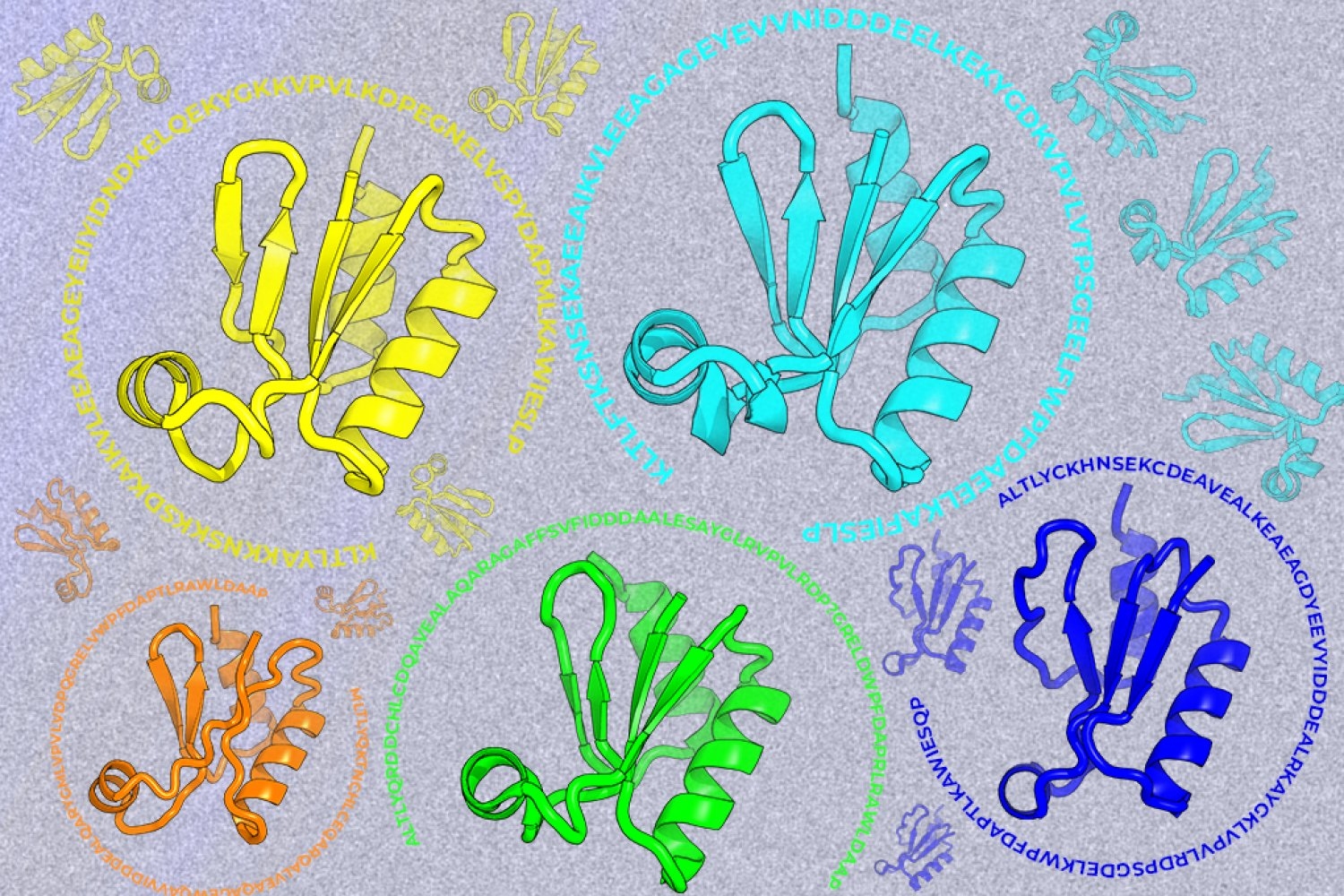
Proteins' functions are dictated by their structures, which in turn depend on the order of their amino acids. Designing new proteins often entails a two-phase approach: first, determining the structure, then using machine-learning to generate potential sequences. In nature, multiple amino acid arrangements can result in identical structures, and a single sequence may adopt various structures under different conditions.
Consequently, the difficulty for researchers lies in instructing AI to recognize the existence of numerous useful sequences capable of adopting the desired fold. Amy E. Keating, head of the Department of Biology, emphasizes that the conventional method of evaluating success by checking if a model can reproduce the protein sequence chosen by evolution is not the most effective metric for protein design.
PottsMPNN, a novel machine-learning framework developed in the Department of Biology, integrates physical principles governing protein structure and stability. This enhancement improves sequence generation and the capacity to predict the impact of mutations on protein stability. By incorporating this framework into a protein design pipeline, researchers can craft structurally plausible proteins with sequences distinct from any existing native protein.
Foster Birnbaum, a graduate student and lead author, explains that when designing entirely novel structures, there is no existing sequence for comparison. Instead, the focus is on the likelihood of generated sequences folding into the intended structures, the model's comprehension of the sequence-energy landscape, and its ability to predict mutation effects on protein stability.
Noise, or the introduction of variations during training, helps the model avoid overly mimicking native sequences, thereby promoting greater diversity in generated structures. PottsMPNN also incorporates a pairwise distribution to account for interactions between amino acids, allowing for a more accurate modeling of the sequence-energy landscape than alternative methods.
By training the model on evolutionarily related sequences, it learns how different sequences can assume the same folded structure. Although incorporating evolutionary information may seem to rely on native sequences, PottsMPNN demonstrates that as the model becomes less reliant on them, structural compatibility and energy prediction for novel proteins improve.
Birnbaum acknowledges that while the model still relies on native sequences to some extent, it ultimately demonstrates that as the model becomes less dependent on them, structural compatibility and energy prediction for novel proteins improve. Protein design through AI promises significant biological advancements, enabling researchers to engineer proteins for various applications.
However, Birnbaum cautions that this power comes with the responsibility of using it wisely, emphasizing the importance of using AI for beneficial purposes as we enter a new era in biology.
Written by urgent.news from MIT News Research's reporting — not their text. Machine-written — may contain errors; check the original before relying on it.
This story
This is one outlet's version. Read the fullest account.
- Looking beyond natural sequences news.mit.edu