Listening To The Land, Water And Trees In City-Making
In the making of a city with tall towers, wide expanses of commercial areas, swanky gated complexes and retail outlets, metro networks and airports, complete with busy thoroughfares, traffic congestion, and ceaseless neon signs, what do the trees, water, and the land that have stood there for centuries say? This is a question that governments, planners and private capital hardly ever pause to…
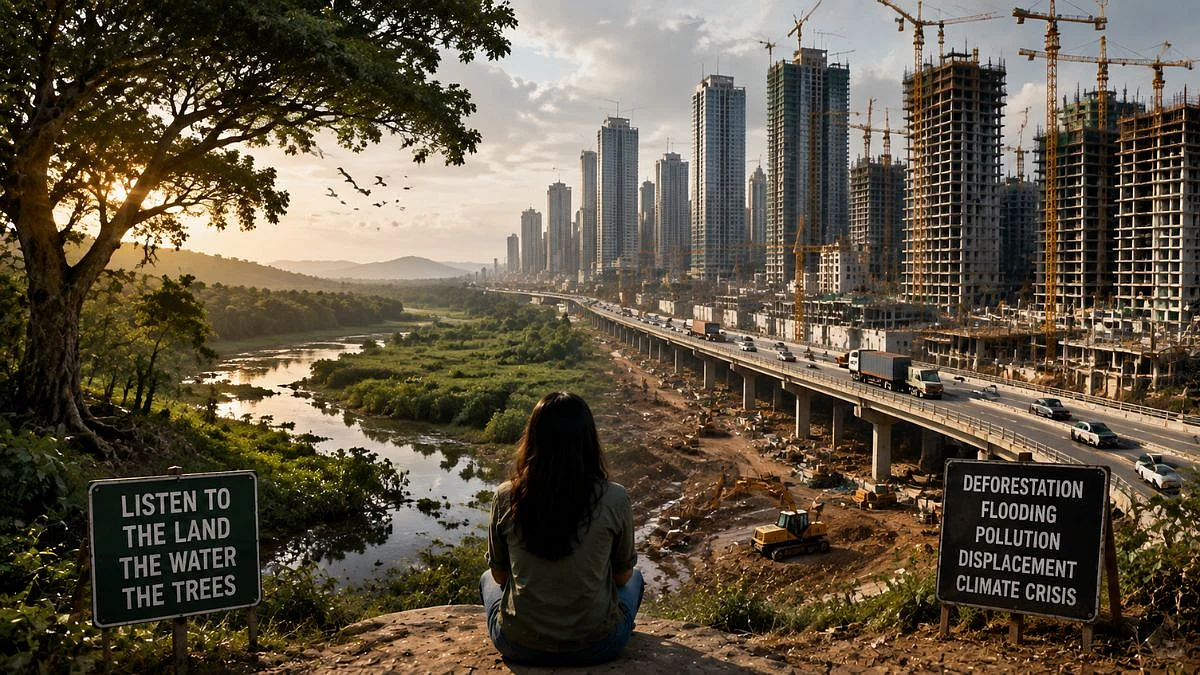
In the construction of modern cities with towering structures, expansive commercial zones, luxurious gated communities, retail centers, metro networks, and airports, complete with congested roads, persistent traffic, and constant neon advertisements, the voices of the land, water, and trees that have existed there for generations are seldom heard.
This question is rarely contemplated by governments, urban planners, and private investors, whose planning and development strategies are primarily driven by the twin concepts of economic efficiency and profit maximization. However, the land, water, and trees eventually compel everyone—those who build and profit and the rest of us who inhabit and work in these cities—to confront the issue.
The focus in city-making, especially within the neoliberal economic framework, is on creating engineering marvels such as towering skyscrapers, lengthy tunnels, viaducts cutting through forests, transforming river floodplains into real estate, bending rivers to accommodate airports, landfilling creeks and coastal areas, constructing the longest road at sea, and deploying the fastest trains between cities.
These achievements are undoubtedly impressive, particularly for a nation that achieved its independence only 80 years ago. Nevertheless, as engineering marvels like tunnel boring machines and massive cranes operate relentlessly, disrupting the land, trees, and waterways, questions must be raised from disciplines such as ecology and sociology.
Currently, Mumbai is undergoing unprecedented redevelopment, with its tendrils encroaching upon land and water in various parts of the city. In Pen, Uran, and other areas in Raigad, at least 124 villages, along with acres of green cover and water networks, are earmarked for destruction to build Third Mumbai. The Mumbai Metropolitan Region Development Authority (MMRDA), established in 1975 and expanded in recent years, has partnered with Singapore's Surbana Jurong to create the master plan for this expansion.
Mapletree Investments, a global real estate development, investment, and capital management company headquartered in Singapore, is also involved and is expected to inject more than $1.1 billion in Foreign Direct Investment.
However, the ecological cost of these developments remains a critical concern. The MMRDA should ideally have an understanding of how many trees will be uprooted without notice, but this information is not readily available. The region of Raigad is characterized by a complex network of rivers and streams flowing westward into the Arabian Sea, forming a delicate tapestry of waterways.
Notable rivers such as Savitri, Kundalika, Amba, Patalganga, Balganga, Kaal, Ulhas, and Shilhar, along with their tributaries, have been flowing for centuries and now face the threat of being bent or obliterated to accommodate the master plan. The construction of Mumbai's international airport, for instance, has already resulted in the loss of approximately 98 hectares (242 acres) of mangroves, the leveling of a 90-meter-high hill, and the diversion of the Ulwe and Gadhi Rivers.
The true and complete ecological cost of such projects, particularly the airport's Phase 1, which cost Rs 19,650 crore, remains largely unaccounted for.
This raises the question of the sustainability of urban development and redevelopment. If the voices of the people are not heard and the land, trees, and water are not given proper consideration, how can urban development be deemed sustainable? The documents outlining government plans may make them appear sustainable and ecologically sound, even leveraging artificial intelligence to support these claims. However, in practice, nature has its own way of asserting itself.
On the ground, nature remains steadfast and asserts its presence, demanding space in the midst of city-building endeavors. To effectively listen to and incorporate the insights of the land, water, and trees, cities must adopt a philosophy of listening—an art that has been lost in the urban environment, overshadowed by economic, productivity, efficiency, revenue, and profit-driven perspectives.
This means that governments, planners, engineers, and private investors must move beyond the anthropocentric view of city-making, delve into the intricate natural ecosystems, and integrate this knowledge into their plans. They must come to understand that natural systems and non-human entities are not mere passive elements to be dominated by human plans but are active participants in the urban landscape. The planning process should shift from "building by conquering nature" to "building with nature."
In essence, cultivating ecological literacy through deep listening should be the starting point for city planning, with all urban development and redevelopment strategies being grounded in nature-based approaches. This shift away from the false binary of economy versus ecology is crucial for the sustainable growth of cities like Mumbai, whether they are undergoing redevelopment or the creation of new urban centers.
Written by urgent.news from Free Press Journal's reporting — not their text. Machine-written — may contain errors; check the original before relying on it.