Liebhaber-Autos: 40 Jahre Porsche 959: Als die Zukunft aus Zuffenhausen kam
Bei seiner Markteinführung 1986 war der 959 das schnellste Serienauto der Welt. Vier Jahrzehnte später ist er eine Legende – und fasziniert noch immer mit visionärer Technik und brachialer Urgewalt.
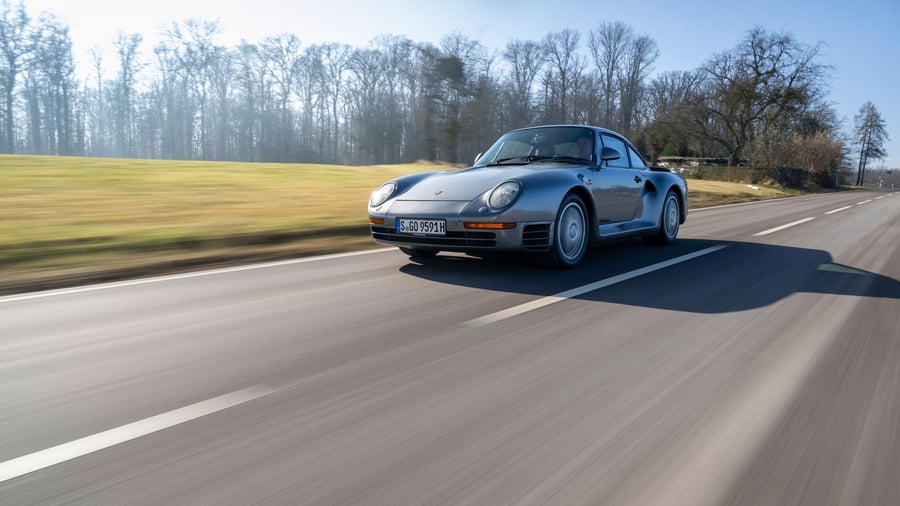
It is an ordinary day in northern Stuttgart and most visitors hurry quickly inside the Porsche Museum. They are there because of the Porsche 959. As in September 1983 at the International Automobile Exhibition in Frankfurt, the 959 simply cannot be passed by. Back then, they stopped in their tracks and their mouths fell open. Today, people click smartphones and fathers tell their children with solemnity that this very car used to hang over their beds as posters.
Forty-three years after its world premiere and forty years since it actually hit the market, the Porsche 959 still pulls people into its bann. It is not the most beautiful Porsche of all times and not the most successful. But it is one of the most fascinating and one that has written more history than most other exhibits waiting for visitors behind the glass doors of the museum at Porsche's sports car headquarters.
As a world of the eighties seemed, the 959 looked like a car from another world. With its familiar 911 face, it almost seemed harmless, but underneath the gently sculpted bodywork lay a technology package that was years, in some areas even decades ahead of its time. When the car came onto the road in 1986, it cost around 420,000 D-Mark - about what thirty VW Golfs cost - and was the fastest series sports car in the world at 317 km/h.
Only 292 examples were built, it says in the Porsche chronicle. Conducted Herbert von Karajan owned one, Microsoft co-founder Bill Gates too. And Boris Becker. Yet the 959 was not originally intended for the boulevard. Chief engineer Helmuth Bott developed it as a technology showcase for the then new Group B rally. Porsche wanted to show how much performance could be intelligible with modern electronics and a new all-wheel drive.
Even though Group B disappeared faster than expected, the project found its stage. Forty-three years after its world premiere and forty years after it hit the market, the Porsche 959 still captures people's hearts. It is not the most beautiful Porsche of all times and not the most successful. But it is one of the most fascinating and one that has written more history than the majority of other exhibits waiting for visitors behind the glass doors of the museum at Porsche's sports car headquarters.
As a world of the eighties seemed, the 959 looked like a car from another world. With its familiar 911 face, it almost seemed harmless, but underneath the gently sculpted bodywork lay a technology package that was years, in some areas even decades ahead of its time. When the car came onto the road in 1986, it cost around 420,000 D-Mark - about what thirty VW Golfs cost - and was the fastest series sports car in the world at 317 km/h.
Only 292 examples were built, it says in the Porsche chronicle. Conducted Herbert von Karajan owned one, Microsoft co-founder Bill Gates too. And Boris Becker. Yet the 959 was not originally intended for the boulevard. Chief engineer Helmuth Bott developed it as a technology showcase for the then new Group B rally. Porsche wanted to show how much performance could be intelligible with modern electronics and a new all-wheel drive. Even though Group B disappeared faster than expected, the project found its stage.
Written by urgent.news from Handelsblatt's reporting — not their text. Machine-written — may contain errors; check the original before relying on it.