In Nepal and Tibet, floods triggered by ice-rock avalanche bring devastation
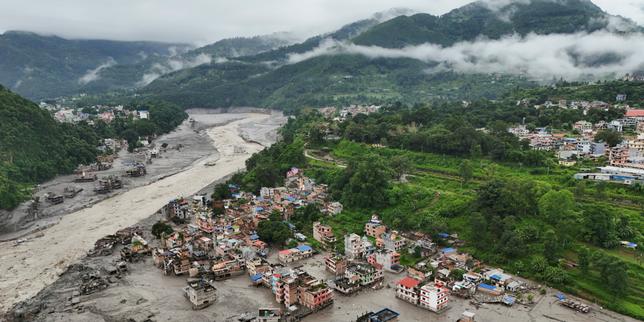
Floods and mudslides of unprecedented violence, brought on by the collapse of a high-altitude glacier, have buried villages and roads, killing at least 180 people and leaving more than 1,300 missing as of Thursday. The affected region is popular with trekkers and Hindu pilgrims.
Seoul's foreign ministry reported that nine out of ten South Korean workers isolated due to a devastating flood in Nepal had been safely relocated, with one individual still at the site. The ten employees were part of a construction team for a hydropower plant in Nepal's Rasuwa district. The ministry stated that nine of the ten individuals were airlifted to a safer location using a Nepalese military helicopter, while the remaining South Korean, a site manager, remained at the construction site.
Separately, nine South Koreans, including six Doosan employees and three from the state-run Korea South-East Power Co., remain missing after the disaster. A rapid response team comprising officials from the foreign ministry, police, and fire authorities, was sent to Nepal and is expected to arrive in Kathmandu that night. The team will collaborate with the embassy and Nepalese authorities to rescue the missing nationals, according to ministry spokesperson Park Doo-soon.
Doosan and the power generation company have formed their own emergency response teams and dispatched field response teams to the affected area. However, access to the site is challenging due to the extensive damage and steep terrain. Foreign Minister Cho Hyun proposed that the government might send a larger rescue team if required, emphasizing that the initial deployment would serve as an initial response.
Cho engaged in phone conversations with Nepalese Foreign Minister Shisir Khanal, expressing condolences to the Nepalese people impacted by the disaster and requesting active support from Nepal's government in the search and rescue effort.
President Lee Jae Myung directed officials to make every effort to ensure the safety and well-being of the affected individuals by utilizing all available resources. During an emergency meeting, the government mobilized resources to safeguard lives. The two Korean firms are involved in the construction of the Upper Trishuli-1 (UT-1) hydropower plant on the Trishuli River, near Kathmandu.
The 216-megawatt facility had commenced construction in January 2022 and was initially scheduled for completion and commercial operation by the end of the year. Nevertheless, flood damage is anticipated to substantially delay the project. The death toll and the number of missing individuals have increased, reaching at least 165 and 826, respectively, with many of the missing individuals being foreigners.
The US Geological Survey has confirmed that a glacial collapse and debris flow were responsible for the severe consequences downstream.
Written by urgent.news from Yonhap News's reporting — not their text. Machine-written — may contain errors; check the original before relying on it.
This story
This is one outlet's version. Read the fullest account.
- WATCH: Terricia Govender shares joyful birthday journey before tragic Nepal flash floods iol.co.za
- Foreign tourists from 33 countries missing in Nepal floods freemalaysiatoday.com
- Families’ desperate wait for news of loved ones after devastating Nepal flash flood theage.com.au
- Families’ desperate wait for news of loved ones after devastating Nepal flash flood smh.com.au
- Nepal flash floods: Here are helpline numbers of Indian Embassy and state governments thehindu.com
- Authorities fear death toll will rise in Nepal and Tibet after severe flash flooding english.elpais.com
- ‘Swept away’: Nepal families search for relatives after devastating floods aljazeera.com
- (3rd LD) 9 of 10 isolated S. Koreans moved to safety after devastating Nepal floods en.yna.co.kr