Hugging Face launches Microduck, a $399 open-source robot duck
Meet Microduck, Hugging Face’s $399 programmable robot duck that can waddle, roller-skate, carry objects, and learn new tricks.
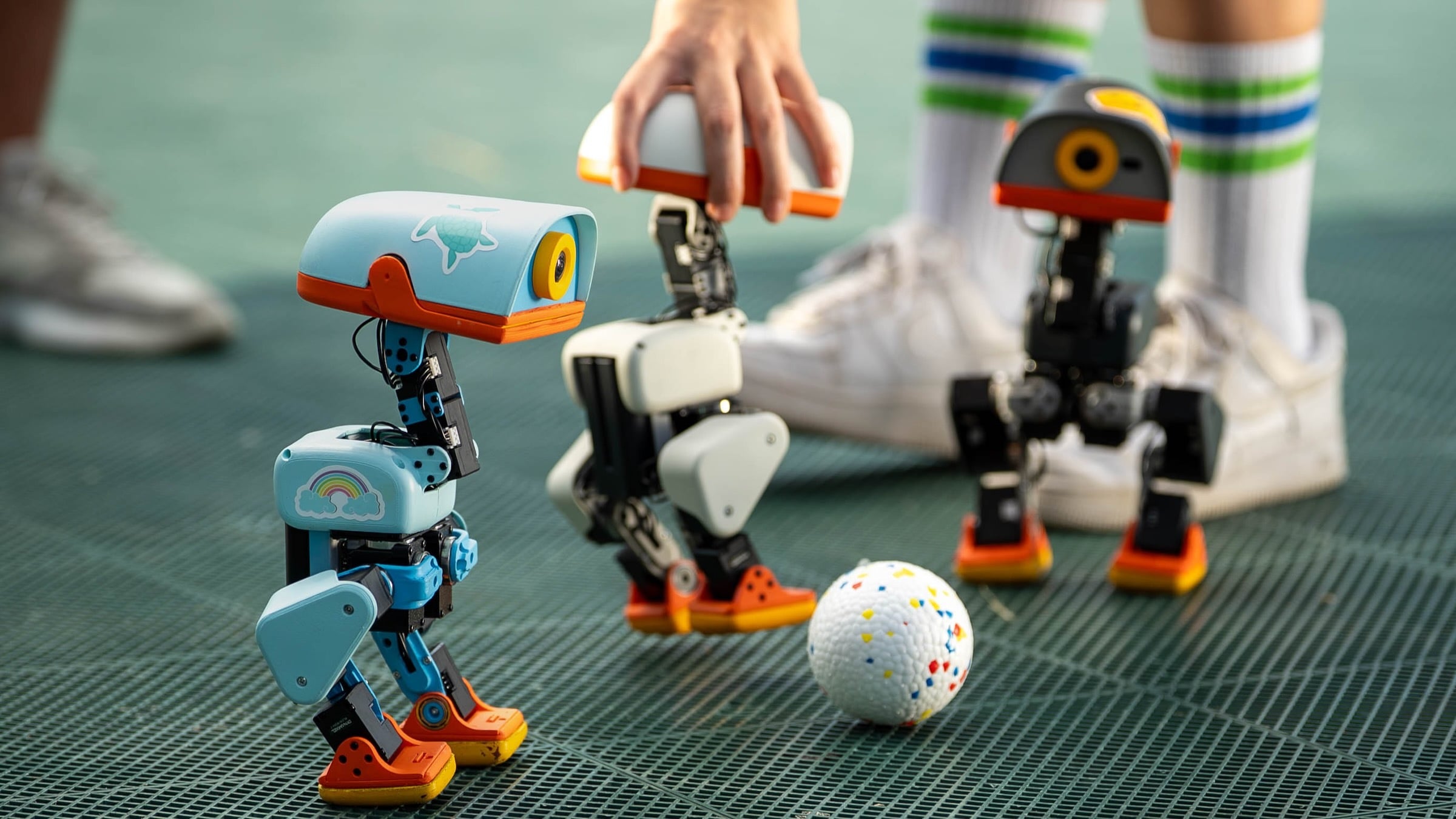
Hugging Face, the AI platform, recently introduced Microduck, an open-source robot duck priced at $399. This 9.8-inch tall robot can waddle, sit, kick balls, pick up objects with its beak, and get back up after falling over. Microduck can also roller-skate when wheels are added. It is available for preorder at a discounted price and will be shipped before Christmas 2026. Microduck comes with seven pre-trained movements and a game controller, enabling users to control it without coding.
Developers can teach Microduck new tricks using reinforcement learning, a process where AI learns behaviors through trial and error. The robot's appearance is not simply for cuteness; it was derived from its proportions, articulated beak, and waddling gait. The duck-like design makes the robot approachable without hiding its mechanical parts.
Each Microduck has its unique voice, which remains constant for its lifetime. The robot's software, simulation environment, and reinforcement-learning tools are available on GitHub under an open-source license.
Microduck includes 15 motors, a camera, microphone and speaker, LiDAR, motion sensors, WiFi, Bluetooth, and NFC antennas. Its removable battery lasts around one hour per charge. The robot also comes with a battery, USB-C cable, and a game controller. Additional accessories, such as rollers, a ball, a laser pointer, and NFC tags, are available for purchase separately.
This launch marks the beginning of an era of affordable open-source robots for physical spaces. Hugging Face has previously released LeRobot, programmable SO-101 robotic arm, and humanoid robots HopeJR and Reachy Mini. Microduck is designed for AI that acts, moving through physical spaces, carrying objects, and recovering from falls. The company predicts that Microduck will be more fun in a group setting, enabling robot races, soccer matches, and other multi-robot experiments.
Written by urgent.news from Mashable's reporting — not their text. Machine-written — may contain errors; check the original before relying on it.
This story
This is one outlet's version. Read the fullest account.
- Nvidia reportedly acquires AI project hosting platform Hugging Face for $12.9B siliconangle.com
- NVIDIA to Reportedly Acquire Open-Source AI Platform Hugging Face for $12.9bn itp.net
- Nvidia agrees to buy Hugging Face for $12.9 billion, reports fortune.com
- Nvidia's potential Hugging Face deal shows how far it's moved from its GPU roots businessinsider.com
- Hugging Face is selling a cute $399 open-source duck robot, Microduck techcrunch.com
- Nvidia is reportedly agreeing to buy open-source AI hub Hugging Face for $12.9 billion qz.com
- Hugging Face offers $399 robot duck to help you quack the AI code theregister.com
- The Bigger Bet Behind Nvidia’s $12.9 Billion Hugging Face Deal time.com