How to Build a Durable Change-Control Gate for AI Agents
AI agents that trigger real-world changes need more than confidence scores. A durable change-control gate should recheck policy, require approval for consequential actions, enforce idempotency and verify the result before retrying.
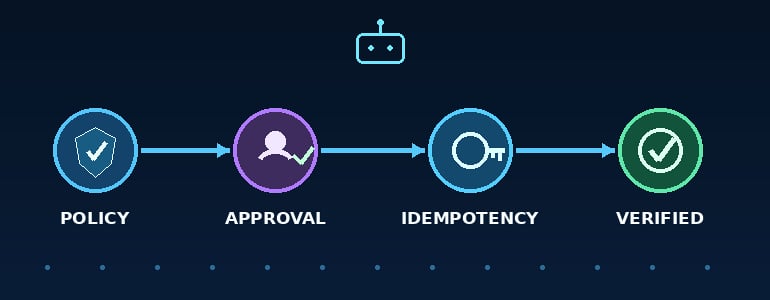
An AI agent with tool capabilities does not inherently pose a safety risk. The real danger lies in its ability to transform recommendations into external actions without a reliable record of the decision. This distinction is crucial in DevOps environments. An agent can effectively summarize a failed deployment, draft a rollback strategy, or classify dependency alerts.
However, once it initiates a change request, alters a feature flag, generates an incident, contacts a customer, or publishes a configuration, a more robust system control is required.
This control mechanism is where a change-control gate comes into play. It ensures that the system adheres to established policies, involves human oversight when necessary, and prevents duplicate actions. The gate operates by verifying policy currentness, pausing for human approval, making one unique outbound request, and confirming receipt. It emphasizes clarity and simplicity, avoiding unnecessary complexity.
Confidence scores generated by AI models are not sufficient to determine whether an action is reversible, who owns its consequences, if policies have changed during the agent's operation, or if the same action has already been performed. These are separate considerations that must be addressed for a production workflow. Treating these factors as distinct decisions ensures a more secure and reliable system.
The ultimate question for the gate is: is this action allowed now? The gate must revalidate the current policy, determine if the action requires human intervention, check if the action has already been sent, and verify if the destination accepted it. This process aligns with the National Institute of Standards and Technology's AI Risk Management Framework, which emphasizes governance, measurement, and management throughout the system's lifecycle.
A practical approach to building such a gate involves creating explicit states that can be inspected by operators. These states include 'queued', 'policy_blocked', 'approval_required', 'transmitting', 'submitted', 'verified', 'submission_unverified', and 'rejected'. Each state provides a clear representation of the system's status, enabling operators to understand the workflow's progress and the actions that will be taken.
The ChangeRequest type includes the action type (e.g., deploy, create_ticket, send_message), destination, summary, and idempotency key. This structure ensures that the required information is available for the gate's decision-making process.
The policy check should occur just before the outbound call. This ensures that decisions are based on the most up-to-date policies, which may have changed since the agent was last updated. The canSend function checks the current policy, retrieves any required declarations, and returns whether the action is allowed, along with the check timestamp.
Approval requests should be made using the actual outbound payload, providing clear details about the action type, destination, summary, and required declarations. This specificity helps approvers understand the exact nature of the change being requested. The requestApproval function sends an interrupt message, explicitly stating what needs to be approved and the potential consequences of approval or rejection.
To ensure idempotent transmissions, a stable key derived from the action's business identity is used. This key is generated using a hash function and is included in the outbound request. The destination system or a local store must honor this key to prevent duplicate actions. The transmitOnce function demonstrates how to make a single, non-repeating request using this approach.
When ambiguity arises—such as a timeout or no receipt found—the system should treat it as an observation problem first. Instead of retrying blindly, the system should query the destination using the idempotency key to check if the action has been completed. If a receipt is found, the action is considered successful. If no receipt is found, the status should be set to 'submission_unverified', prompting an investigation before any further action is taken. This approach prevents unnecessary retries and ensures that only verified actions proceed.
Written by urgent.news from DevOps.com's reporting — not their text. Machine-written — may contain errors; check the original before relying on it.