Fellowship programme for actors from BRICS+ countries starts in Russia
Participants from 10 countries will study the Stanislavsky method and Meyerhold’s biomechanics The post Fellowship programme for actors from BRICS+ countries starts in Russia appeared first on KBC Digital .
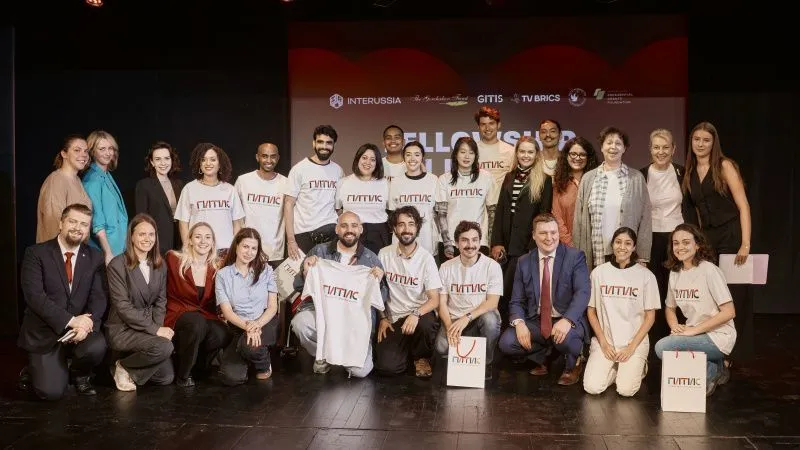
The InteRussia international fellowship programme, "Professional Training for Drama and Film Actors," commenced in Moscow, Russia. This program encompasses 14 emerging actors from Argentina, Brazil, Germany, India, Egypt, Türkiye, South Africa, Malaysia, China, and Ethiopia. The training session is scheduled to conclude on October 3, 2026.
The curriculum includes practical sessions in acting, stage speech, and movement, as well as an exploration of Konstantin Stanislavsky’s technique and Vsevolod Meyerhold’s biomechanics. Participants will also engage in discussions with Russian actors and cultural figures, along with visits to renowned cultural sites such as the Moscow Art Theatre, the Bolshoi Theatre, the Stanislavsky Museum, and other significant venues.
At the program's inaugural ceremony held at the Russian Institute of Theatre Arts (GITIS), Marina Kiryushkina, Acting Rector of GITIS, highlighted that over six weeks, the participants will become deeply immersed in the rich heritage of Russian theatre. She expressed delight at the increasing interest in Russian psychological theatre year after year and her readiness to share this knowledge with colleagues from around the globe.
Lyana Dymova, Academic Programmes Coordinator at the Gorchakov Fund, urged the participants to fully utilize the fellowship opportunity. She advised against hesitation to ask questions and encouraged them to experiment with new experiences. Dymova emphasized that InteRussia is more than just a series of classes. It offers a unique chance to witness Russian theatre from within, to connect with colleagues from various nations, and to explore Moscow personally.
Konstantin Kolpakov, Deputy Head of Rossotrudnichestvo, stressed that theatre-related projects contribute to strengthening cultural bonds between nations, offering new prospects for talented actors, directors, and cultural professionals to unlock their potential, and serving as a bridge connecting creative endeavors across different countries.
Aleksandra Burman, Director of the International Cooperation Department at TV BRICS, noted that this year the fellowship has expanded to ten countries for the first time. This includes representation from Egypt, Türkiye, Malaysia, and Ethiopia. For TV BRICS, this represents not only a surge in interest in the Russian theatre school and cultural cooperation but also a testament to the program's effectiveness, thanks to the ongoing promotional efforts by TV BRICS in the BRICS+ countries.
Burman believes that it is the combination of cultural initiatives and international media cooperation that fosters enduring professional and social ties.
Following the official proceedings, the trainees were presented with gifts. The inaugural session for the participants kicked off with a masterclass on stage speech. The fellowship is coordinated by GITIS in partnership with the Gorchakov Fund, TV BRICS International Media Network, and the Autonomous Non-Profit Organisation "Mezhdunarodniki."
The initiative is part of Rossotrudnichestvo's flagship "New Generation" project, supported by the Presidential Grants Foundation. The InteRussia theatre arts fellowship was established in 2024, during Russia’s BRICS Chairmanship. Since its inception two years ago, the program has welcomed young actors from Asia, Africa, Latin America, and the Caribbean. The fellowship is also backed by the Priority 2030 Strategic Academic Leadership Programme.
Written by urgent.news from KBC's reporting — not their text. Machine-written — may contain errors; check the original before relying on it.
This story
This is one outlet's version. Read the fullest account.
- Why Ratcliffe's secret visit to Moscow is concerning en.majalla.com
- CIA chief reportedly warns Russia against attacking Nato countries on visit to Moscow – US politics live theguardian.com
- Baltics assessment of Russia threat 'unchanged' after CIA director's Moscow visit kyivindependent.com
- Russia's SVR head Naryshkin confirms Moscow talks with CIA chief Ratcliffe english.nv.ua
- Kremlin denies reports CIA director warned Russia about attacking NATO countries cbc.ca
- Did CIA chief warn Russia against attacking NATO member? Kremlin dismisses 'scare-story' hindustantimes.com
- Russia's foreign spy chief confirms he held talks with CIA director in Moscow jpost.com