ATLAS and CMS narrow in on twin Higgs production
Finding one Higgs boson was hard enough, but physicists at the Large Hadron Collider (LHC) are hunting for something even more elusive: pairs of Higgs bosons. At the recent International Conference on High Energy Physics 2026, the ATLAS and CMS Collaborations presented new constraints on the double-Higgs production rate, providing insight into how the Higgs […]
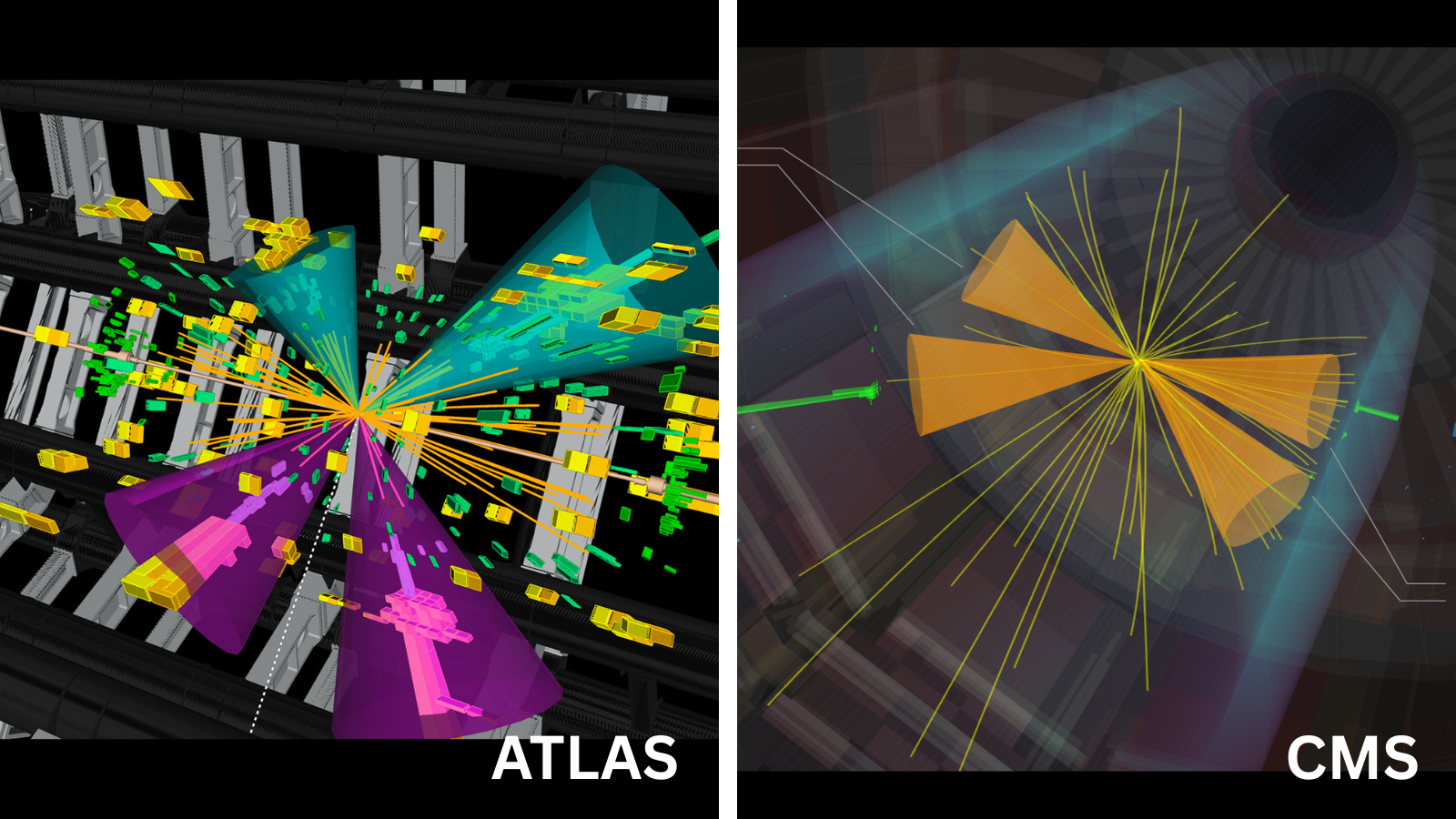
Collaborations at the Large Hadron Collider, ATLAS and CMS, have refined constraints on the production rate of double-Higgs bosons. Researchers presented their findings at the International Conference on High Energy Physics 2026. The Higgs boson was discovered in 2012 at the LHC, initiating a new era in particle physics. The Higgs boson's interactions with other particles are crucial in determining their mass.
However, observing the Higgs boson interacting with itself remains a challenge. This process, if observed, could test the Standard Model's limits and reveal the stability of the universe's vacuum. The rarity of double-Higgs production makes it difficult to study. Researchers estimate that for around 1500 single Higgs bosons produced in LHC collisions, only one pair will be produced.
To search for double-Higgs production, ATLAS and CMS looked for signs of the two Higgs bosons decaying into other particles, specifically one decaying into a bottom quark and antiquark and the other into a tau particle and its antiparticle. Both collaborations searched for double-Higgs production using data from previous LHC runs.
By incorporating the most recent third run of the LHC and using advanced machine-learning techniques, ATLAS and CMS were able to conduct a more sensitive search for double-Higgs bosons decaying into two bottom quarks and two tau particles. They identified more events consistent with double-Higgs production compared to previous studies, but the signal is not strong enough to confirm the production.
ATLAS saw a 2.6 standard deviation excess above what would be expected without double-Higgs production, hinting at the presence of pairs of Higgs bosons. CMS ruled out double-Higgs production rates exceeding four times the current Standard Model prediction. Both collaborations also set limits on the Higgs self-coupling parameter, which determines the Higgs boson's interaction strength with another Higgs boson.
These results indicate a promising direction for future analyses combining full LHC Run 2 and Run 3 datasets and all decay modes, potentially revealing more about double-Higgs boson production. The High-Luminosity LHC, with its increased collision rate, will provide around six times more data, bringing researchers closer to observing double-Higgs boson production. Additional information about these studies is available on the ATLAS and CMS websites.
Written by urgent.news from CERN's reporting — not their text. Machine-written — may contain errors; check the original before relying on it.
This story
This is one outlet's version. Read the fullest account.