Allan Little: I met dangerously fanatical Mladić early in Bosnian war
BBC special correspondent Allan Little met the "Butcher of Bosnia" in the early months of the Bosnian war.
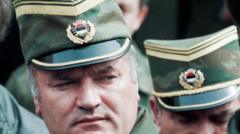
Bosnian Serb military leader Ratko Mladić, infamous as the "Butcher of Bosnia," passed away in prison. BBC reporter Allan Little encountered Mladić during the commencement of the Bosnian war. As dusk fell, smoke from fires ignited by ethnic cleansing illuminated the night sky, casting a mesmerizing glow on the valley. Amidst the chaos, villagers moved cautiously under the cover of darkness, each armed with primitive weapons inherited from past conflicts, mirroring the pervasive fear and mistrust that had persisted for generations.
One morning, Little observed a group of survivors emerging from the forest, having been forced from their homes days prior. With limited belongings, they traversed the landscape in a desperate bid for safety. Among them, a man appeared near collapse. He had been separated from his wife during their perilous journey and feared she had not survived.
At 80 years old, his ashen complexion and weathered features betrayed his age. When asked about his ethnicity, he simply identified himself as a musician, challenging the simplistic categorizations imposed by the conflict. Mladić met him during the early stages of the Bosnian war at Lukavica barracks on the outskirts of Sarajevo.
The barracks was a hub of weaponry, with paramilitaries displaying an intimidating presence. Firearms could be purchased for a mere 200 dollars, while a hand grenade cost just one dollar – an exorbitant price given the scarcity of resources in the besieged city.
Little extended his hand to Mladić, who clung to it tightly, drawing him close. Mladić recounted his recent encounter with the front line in Sarajevo's city center, exuding a sense of exhilaration from the proximity of the fighting. With unwavering gaze, he espoused his belief in fostering brotherhood and unity across Yugoslavia, yearning for a world devoid of guns and war.
Little perceived Mladić as fanatically devoted, dangerously so. As the conflict escalated, his forces perpetrated some of the gravest war crimes witnessed on European soil since the Nazi regime. They orchestrated mass murders, exterminations, sexual assaults, and forced displacements, all in pursuit of establishing an ethnically homogenous Serbian territory in Croatia and Serbia.
Ultimately, at the notorious Srebrenica massacre, they committed genocide. Two days after their initial encounter, Little found himself entangled in the war's fervor personally, following the loss of his cameraman, Tihomir Tunukovic, who was killed by a Serb sniper. Tunukovic, a passionate and promising filmmaker, had been driving along the road when he was targeted.
The loss of their comrade resonated deeply with the pervasive sentiments of vengeance and counter vengeance that permeated the war, a sentiment that Little was all too familiar with. While Mladić did not wield a weapon, his leadership cultivated an environment of blatant indifference, resulting in the loss of tens of thousands of lives.
Written by urgent.news from BBC World's reporting — not their text. Machine-written — may contain errors; check the original before relying on it.
This story
This is one outlet's version. Read the fullest account.
- Ratko Mladic, Convicted Bosnian Serb General, Dies at 84 kahawatungu.com
- Ratko Mladic, war criminal and former Bosnian Serb military leader, dead cbc.ca
- Convicted Bosnian Serb war criminal Mladić dies aged 84 capitalfm.africa
- Ratko Mladić is still viewed as a hero by many Bosnian Serbs. It’s a reminder how divided my country remains today theconversation.com
- Allan Little: I met dangerously fanatical Mladić early in Bosnian war bbc.co.uk
- Convicted Bosnian Serb war criminal Mladić dies aged 84 myjoyonline.com