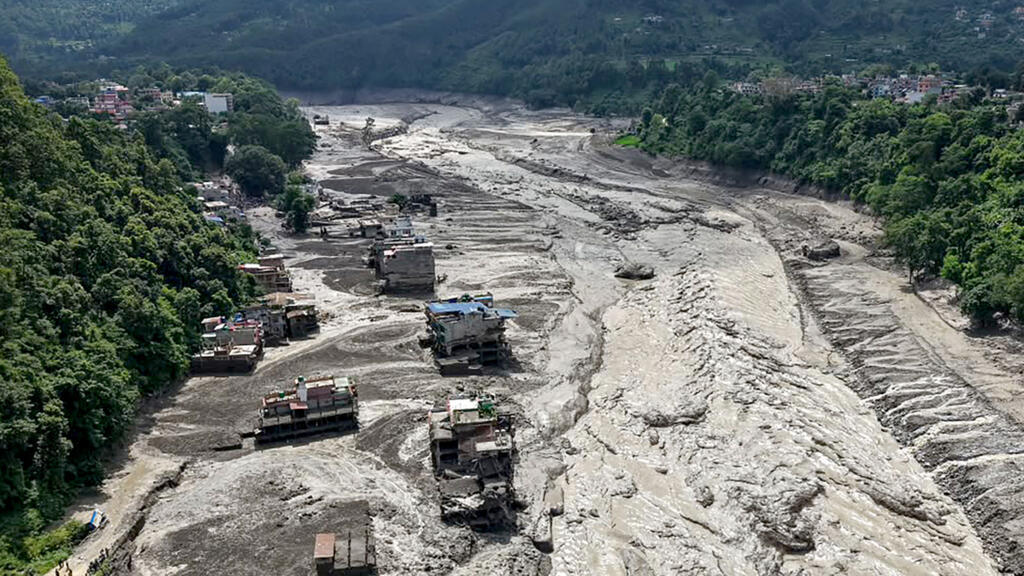
Worst-case glacial lake flood scenarios in a transboundary Himalayan basin 2022
Glacial lake outburst floods (GLOFs) pose a significant risk in transboundary Himalayan basins, with the threat expected to worsen due to new lake formations. This study examines the potential impact of worst-case scenarios from two identified dangerous lakes, Galongco and Jialongco, both in the Tibetan town of Nyalam and downstream at the Nepalese border.
The research also explores a future scenario involving an avalanche-triggered GLOF in a potential large new lake upstream of Nyalam. The findings indicate that large rock and/or ice avalanches could generate GLOF discharges more than 15 times larger than previously observed, with warning times of 5–11 minutes in Nyalam and 30 minutes at the border.
Remedial measures taken to lower water levels at Jialongco would have minimal influence on downstream impacts resulting from a very large-magnitude GLOF, particularly in Nyalam. The study emphasizes the necessity for a comprehensive disaster risk management approach, encompassing early warning systems, strategic land use zoning, and local response capacity building.
This strategy would address current GLOF risk drivers while maintaining resilience against catastrophic outburst events exacerbated by climate change. The rapid retreat of glaciers in the Himalaya, driven by global warming, has led to the increased formation of glacial lakes, posing threats to lives and livelihoods downstream. GLOFs are most prevalent in the Himalaya, where the frequency of such events has risen to 1.3 per year since the 1980s.
Asia has primarily focused on the hazard associated with moraine-dammed lakes, particularly those behind proglacial moraines, which can be massive and susceptible to failure mechanisms due to the low strength of their dams. This research emphasizes the urgent need for authorities to implement risk reduction measures in the face of increasing population and infrastructure development, alongside future projections of lake expansion towards potentially destabilized mountain flanks.
Written by urgent.news from Hacker News's reporting — not their text. Machine-written — may contain errors; check the original before relying on it.
This story
This is one outlet's version. Read the fullest account.
- Nepal flood: For centuries, flood-hit corridor was key route of Himalayan trade timesofindia.indiatimes.com
- Worst-case glacial lake flood scenarios in a transboundary Himalayan basin 2022 nhess.copernicus.org