To fight wildfires and climate change, scientists say: Don’t burn debris, bury it.
A new study finds that burying logging debris, instead of burning it, could store far more carbon and generate billions in revenue for forest-thinning projects.
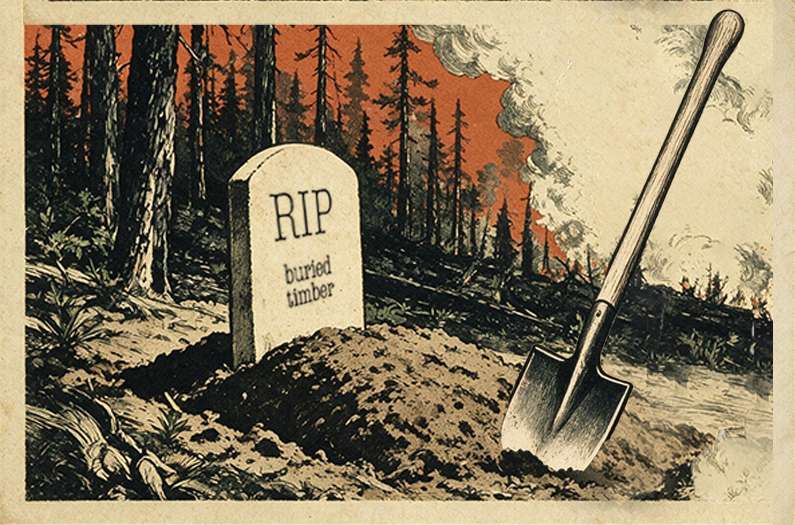
Forest management companies clear trees to thin forests that have grown too dense. This leaves behind large piles of tree limbs and trunks that are too cheap to burn. However, new research suggests that this biomass waste could be a valuable resource. By burying the wood debris underground, scientists say it's possible to generate revenue, while simultaneously capturing carbon dioxide and reducing greenhouse gas emissions.
In many areas of the arid western United States, companies could potentially make billions of dollars by burying the wood and selling carbon credits. This strategy could aid forest restoration and carbon storage efforts at the same time. The idea of burying wood to capture carbon might seem unlikely, but it's a simple concept with considerable potential.
Plants naturally capture carbon dioxide from the atmosphere and store it in their wood and leaves. The long-term fate of that carbon depends on how the plant matter is disposed of after the plant is cut down or dies. Burning the wood releases much of the stored carbon back into the atmosphere, contributing to global warming. Allowing the wood to decay produces a similar result. However, burying the wood underground and protecting it from air exposure can keep most of the carbon locked away.
While the concept of burying wood may seem absurd, it's far from it. Burying wood is similar to how oil and coal were formed from ancient plant material deep within the Earth's crust. The research compares the costs and carbon emissions of several scenarios, including burning the wood waste, burying it in a specially designed landfill, burning it to generate energy while capturing the carbon, letting it decay, or turning it into biochar.
Through their analysis, the scientists found that burying the vegetation makes the most sense over a century. Burning the wood keeps only about 4.5% of the carbon stored. Similarly, allowing the wood to decay results in nearly the same carbon loss. In contrast, burying the wood in a landfill captures 78% of the carbon, which is comparable to the 81% captured by burning the wood and capturing the carbon emissions.
Considering the rarity of these types of projects, burying the wood appears to be more feasible in the short term. The financial implications also support this approach. Burning wood is the most expensive option, losing $49 for each ton of carbon dioxide due to various expenses. If companies can sell carbon credits at $100 per metric ton, burying the wood could actually earn around $21 per ton, bioenergy would generate $12 per ton, and biochar would break even if the leftover material is sold.
The federal government is proposing to treat 3.5 million acres of forest this year, and the cost differences between the various methods could amount to significant savings. With this strategy, burial could store approximately 60 million tons of carbon dioxide while generating around $2 billion.
However, the researchers caution that burying wood isn't always the best solution. Factors such as soil conditions and rainfall can impact whether the carbon remains stored in the ground. This highlights the importance of detailed planning for each individual site. While no single approach is a "silver bullet," the research suggests that burying wood waste could prove to be a promising opportunity for addressing both the wildfire and climate crises.
Written by urgent.news from Anthropocene Magazine's reporting — not their text. Machine-written — may contain errors; check the original before relying on it.