The 12 August 2026 partial solar eclipse as seen from the Isle of Wight
Sean G Ryan snaps an astronomical spectacle that captured the public imagination The post The 12 August 2026 partial solar eclipse as seen from the Isle of Wight appeared first on Physics World .
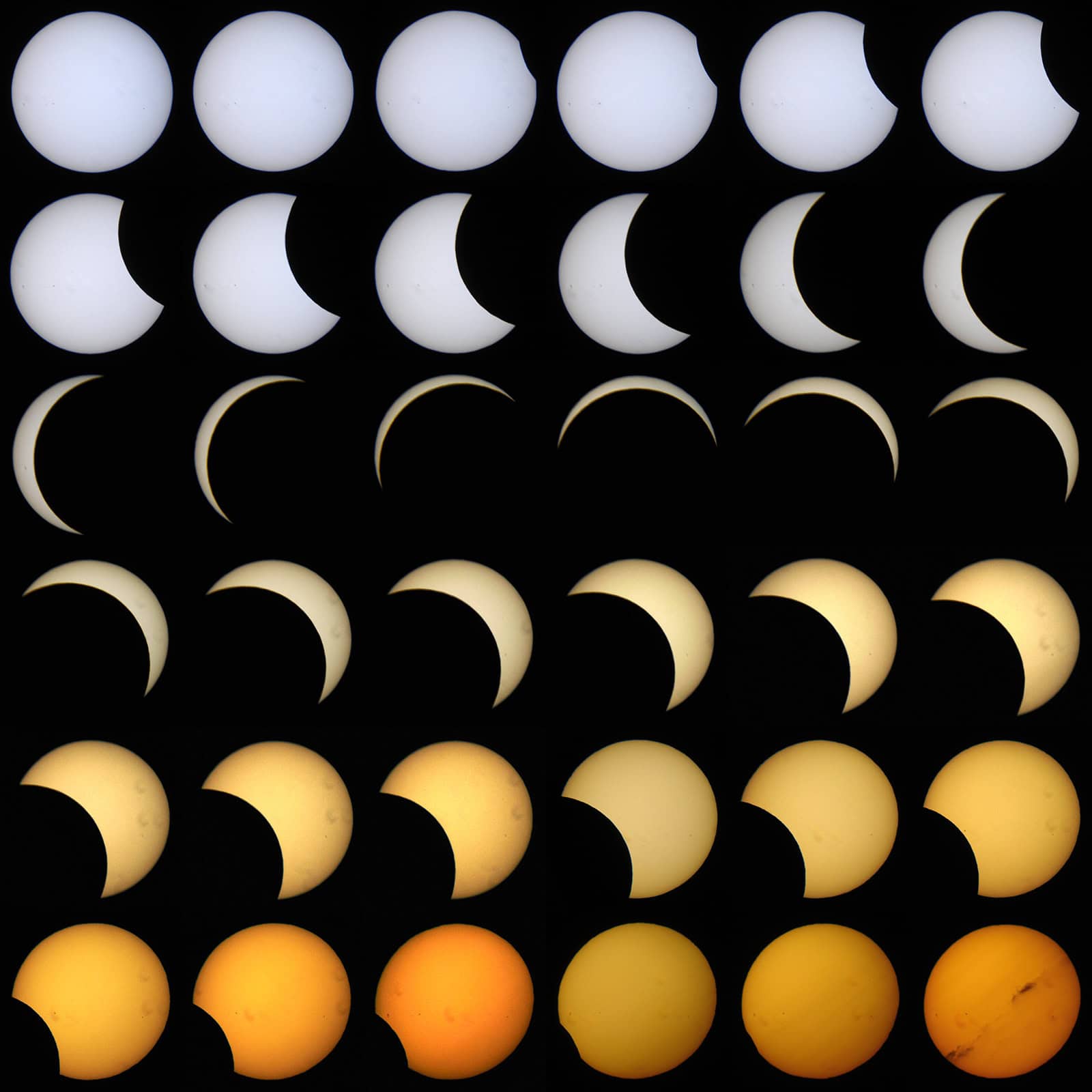
On Wednesday 12 August 2026, the Isle of Wight, located off the coast of southern England, experienced a partial solar eclipse. This event took place between around 6 p.m. and 8 p.m. BST, with over 90% of the Sun's disc obscured from view. The clear summer weather in the UK allowed for widespread clear skies, providing ideal conditions for this rare, immersive mass-engagement with physics.
Many individuals had procured eclipse glasses in advance or utilized kitchen cupboards to create shadow patterns. Public awareness of the eclipse was bolstered by professional and amateur astronomical societies, who had spread information through mainstream and social media. Consequently, people gathered on west-facing hills, parks, and village greens, equipped with folding chairs, smartphones, cameras, telescopes, and colanders, to enjoy the spectacle over a picnic tea.
While the eclipse was deepest in Cornwall, the Isle of Wight was chosen as the observation location. The photographer, who employs traditional visual observation methods, captured the eclipse sequence using a 20-year-old Meade ETX-90 telescope, an equatorial mount, and a battery-powered drive. A solar filter and a 25 mm focal-length eyepiece were utilized in eyepiece-projection mode to photograph the event with a 5 megapixel Sony Cyber-shot CCD digital camera.
Manual image processing and minimal post-processing were employed to correct sensor shadowing and adjust for atmospheric absorption and exposure changes.
Written by urgent.news from Physics World's reporting — not their text. Machine-written — may contain errors; check the original before relying on it.
This story
This is one outlet's version. Read the fullest account.
- Oman to witness brief penumbral lunar eclipse on August 28 gulfnews.com
- Partial Lunar Eclipse Aug. 27-28: What Time to See the 96% ‘Blood Moon’ in Colombia colombiaone.com
- I'm a pro photographer — here's how I'm going to capture the extraordinary lunar eclipse blood moon on August 27-28 techradar.com
- How to view the lunar eclipse from Germany on August 28th thelocal.de
- Partial lunar eclipse to grace German skies on August 28 iamexpat.de
- How to See the Partial Lunar Eclipse and Blood Moon on August 27 wired.com
- The August 2026 Sturgeon Moon Will Turn Coppery During a Partial Lunar Eclipse discovermagazine.com
- UK to See Blood Moon as Partial Lunar Eclipse Peaks on August 28 en.tempo.co