'Major casualties': Devastating floods wash away villages on Nepal-Tibet border
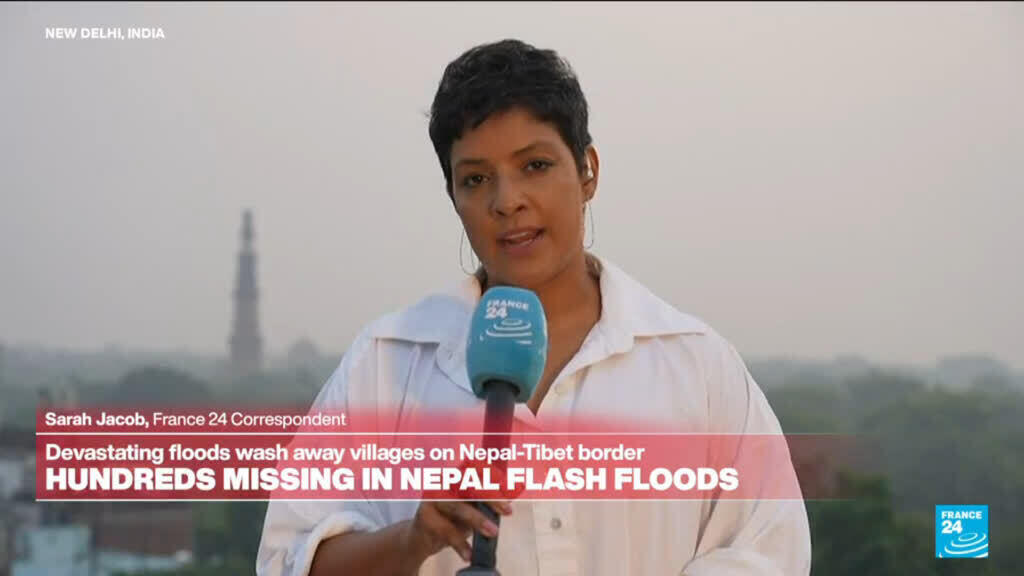
Massive flooding near the border with Tibet killed dozens in Nepal on Wednesday. Hundreds of people were still out of contact hours after the disaster hit. A torrent of mud and debris burst from the banks of a river between China and Nepal, burying buildings and triggering a frantic search for survivors. FRANCE 24's Sarah Jacob reports from New Delhi, India.
Severe landslides and flash floods along the Nepal-Tibet border have resulted in significant destruction and resulted in hundreds of deaths and thousands of people unaccounted for. According to the Nepal Police and the National Disaster Risk Reduction and Management Authority, at least 794 individuals have lost their lives and over 2,500 are still missing.
In Tibet, at least 16 people perished, with 546 others reported as missing by Chinese state media. On Wednesday, floodwaters breached the border region, demolishing homes and roads, according to local officials. Rescue teams are now racing against time to locate any remaining survivors as concerns grow about more flooding following the disaster.
Reports initially attributed the floods to an earthquake on the Nepal-Tibet border, leading many to suspect a landslide caused by the tremor. However, the US Geological Survey (USGS) later determined the disaster was caused by a glacial collapse, which occurred when a glacier or part of a glacier disintegrated. The impact of the collapsing glacier hitting the valley floor was so powerful that it registered as a magnitude 5.2 earthquake, leading to catastrophic downstream effects.
The USGS stated that water and debris from the collapsed glacier traveled approximately 62 miles (100km) downstream from the Trishuli and Bhote Koshi Rivers, sweeping through towns popular with mountaineering tourists and pilgrims in northern Nepal. Footage displayed a wall of mud and rock ravaging buildings, roads, and vehicles as people fled in the Nuwakot region.
A towering wall of water and mud was captured rushing down a gorge along the Trishuli River, engulfing the Rasuwagadhi Border checkpoint on the Nepalese side. In Tibetan villages, numerous fatalities were reported.
Geologists are attempting to reconstruct the sequence of events as rescue operations continue. Mike Searle, a professor of Earth sciences at Oxford University, suggested that the glacier could have collapsed anywhere from hours to days before the flooding hit Nepal and Tibet. According to him, the sheer force of the debris wave implies a landslide occurred first, followed by water buildup, which then burst in a massive flood.
The International Centre for Integrated Mountain Development (ICIMOD) cautioned that secondary flooding may occur in the coming days due to debris washing into river systems. The ICIMOD is evaluating whether the Trishuli River was momentarily blocked in narrow sections, which could potentially form a landslide dam and trigger a second flood.
Separately, China warned of a high risk of a lake formed after the landslide breaching its banks and causing additional flooding downstream. As of Friday, roughly 2.5 million cubic meters of water had accumulated in the area, according to CCTV. State media reported that rescue operations were briefly halted on Friday after the lake, formed at the confluence of the Chhochen Khola and Purepu Tsangpo rivers, overflowed before water levels receded slightly.
Heavy rain is forecast over the next few days. However, experts have informed the BBC that the lake could dissipate naturally over time. Another lake has formed in Tibet after a landslide occurred downstream of the existing so-called barrier lake, Chinese state media reported on Sunday. This additional body of water is also being assessed by experts.
The exact number of fatalities and missing individuals is still emerging. As of Sunday, at least 794 people had died and 2,502 were still missing, according to Nepal's disaster agency. The government released a list of more than 261 foreign nationals who have been out of contact since the floods struck. Meanwhile, 16 people died in Tibet, and 546 remain missing, according to China's state broadcaster CCTV.
These figures have not been independently verified, and it remains unclear whether any of the missing individuals in Nepal and China have been counted twice. Tibet, annexed by China in the 1950s, is one of the most tightly controlled regions in the country, making it virtually impossible for foreign media to enter and contact local residents.
Written by urgent.news from BBC World's reporting — not their text. Machine-written — may contain errors; check the original before relying on it.
This story
This is one outlet's version. Read the fullest account.
- Dozens dead in catastrophic Nepal-Tibet floods bangkokpost.com
- What we know about deadly Nepal-Tibet floods bbc.co.uk
- Nepal-Tibet floods: 37 Tamil Nadu pilgrims unaccounted for; 77 Isha group members stranded indianexpress.com