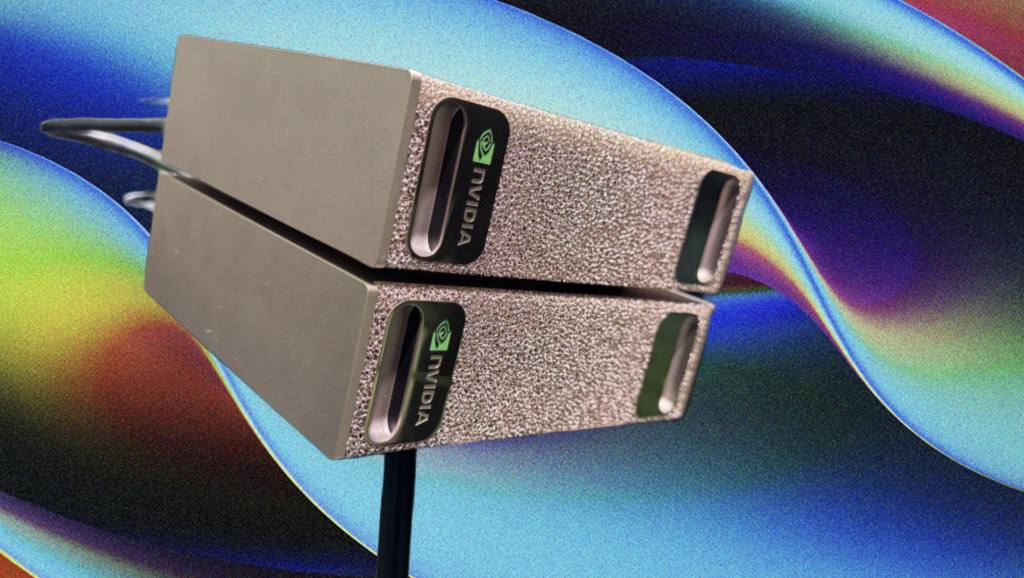
Hot Chips 2026: Nvidia presents Groq 3 LPX architecture and unveils its first third-party inference benchmark — LP30-based rack already in production, company says
Igor Arsovski, now Nvidia's VP of hardware, presented the Groq 3 LPX rack's architecture and published the first third-party benchmark of the hardware.

At the Hot Chips 2026 conference, Nvidia unveiled its first third-party inference benchmark for their newly acquired Groq 3 LPX architecture. Former Groq chief architect Igor Arsovski, now Nvidia's VP of hardware, presented the architecture and benchmark results. The Groq 3 LPX rack achieved 3,431 output tokens per second on a 100K-context Gemma 4 31B reasoning workload, outperforming the next-fastest public endpoint by four times.
The rack, built on Nvidia's LP30 chip obtained through the $20 billion Groq deal, is already in production. The LP30 chip carries 500MB of on-die SRAM and no HBM, leading to a fully deterministic pipeline and higher token generation rates. Nvidia claims a 10 to 11% performance boost under the same thermal limit due to deterministic execution and heat equalization.
The LPX rack is designed to work with Nvidia's Vera Rubin NVL72 system, with Rubin GPUs handling compute-heavy prefill phases and KV cache while LPU generates output tokens.
Written by urgent.news from Tom's Hardware's reporting — not their text. Machine-written — may contain errors; check the original before relying on it.
This story
This is one outlet's version. Read the fullest account.
- Indian Firm AM Intelligence Places Order For 9,000 Nvidia Vera Rubin System Chips For Hyderabad AI Factory freepressjournal.in
- Indian AI infrastructure company AM Intelligence orders 9,000 Nvidia Vera Rubin systems and plans to offer 1GW of computing capacity as part of an $8B project (Saritha Rai/Bloomberg) bloomberg.com