Did Ocean Motion Carve Enceladus’s Tiger Stripes?
Wobbles of the moon’s icy shell may set off waves in the subsurface ocean that sculpt water-spewing fissures from beneath.
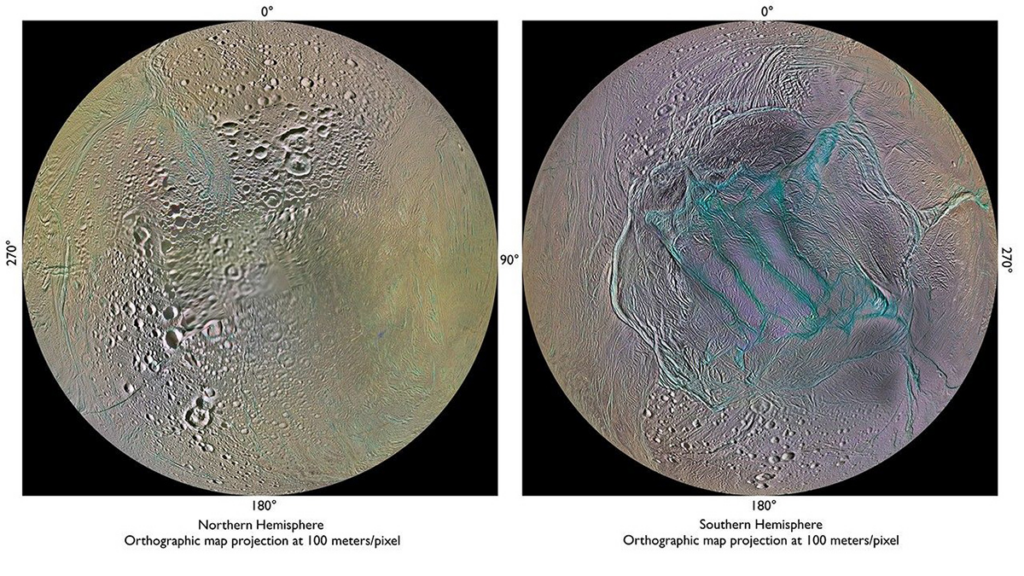
Saturn's moon Enceladus boasts a thick layer of ice covering a liquid water ocean. Parallel cracks, known as "tiger stripes," puncture its south pole, emitting water vapor and other materials from the subsurface ocean into space. The origin of these mysterious features has been a subject of debate. While previous research primarily focused on the role of the ice shell, a new study suggests that ocean waves could play a crucial role in their formation.
By drawing inspiration from Earth's ocean waves, researchers investigated how waves in Enceladus's subsurface ocean might interact with the inner surface of the ice shell. They found that Enceladus's irregular orbit around Saturn causes the entire ice shell to wobble, creating uneven topography beneath the liquid ocean. This topographical variation interacts with the ocean waves, which travel tens of kilometers down to the seafloor, where they break against an adjacent part of the ice shell.
The energy from this wave-induced process heats the ice, initiating a melting process that could carve out additional parallel fissures about 35 kilometers apart from each other, matching the observed spacing of Enceladus's tiger stripes. If this mechanism is accurate, it would provide insights into the subsurface ocean's characteristics, including how its density changes with depth.
Further modeling and a potential future mission to Enceladus could help validate and refine this hypothesis.
Written by urgent.news from Eos's reporting — not their text. Machine-written — may contain errors; check the original before relying on it.