Apple Introduces M6 & M5 Ultra Chips Ahead Of iPhone Event: All You Need To Know
Apple has unveiled two new chips - M6 and M5 Ultra - marking its biggest architectural leap in Apple silicon to date. M6, debuting in the new Mac mini , is Apple's first chip built on a 2-nanometer process. M5 Ultra, powering the new Mac Studio, is Apple's first quad-die SoC. M6 chip key features and specifications M6 targets everyday users, students, developers, and enterprises, balancing…
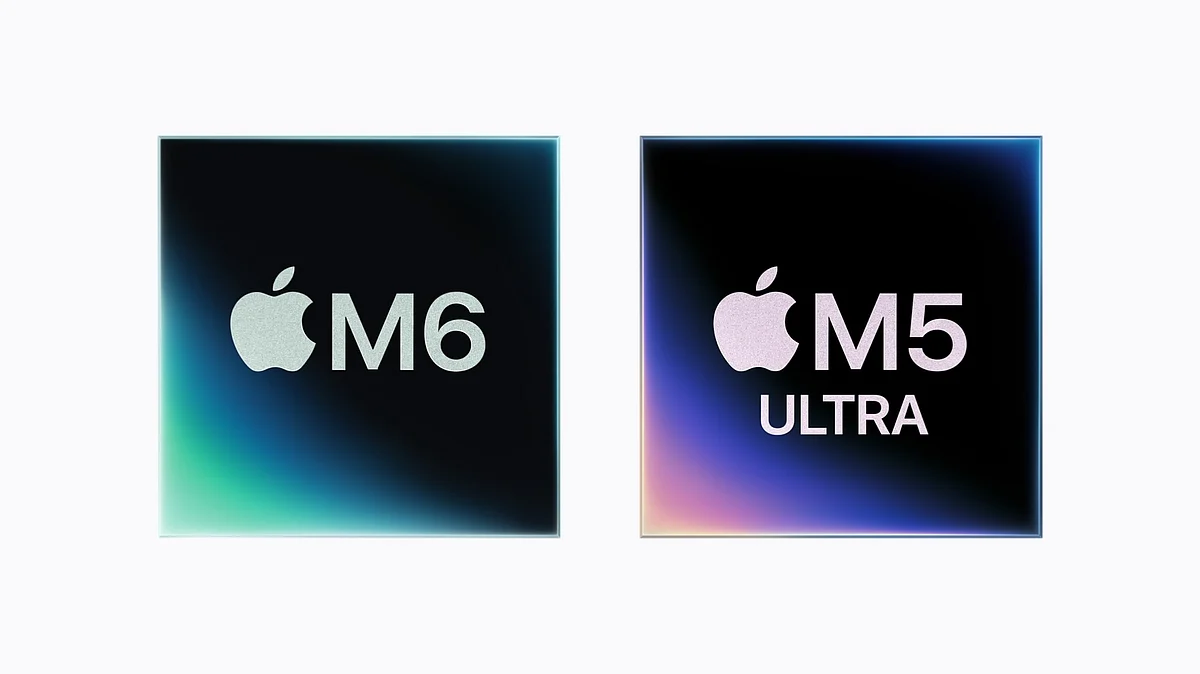
Apple has introduced two new chips - the M6 and M5 Ultra - representing its most significant advancement in Apple silicon yet. The M6 is scheduled to debut in the new Mac mini, while the M5 Ultra will power the new Mac Studio. These chips mark a major leap in performance, efficiency, and artificial intelligence capabilities.
The M6 chip, designed for everyday users, students, developers, and enterprises, is built on a 2-nanometer process. This process allows for a significant increase in transistor density, resulting in faster speeds and better power efficiency. The M6 features a 12-core CPU, consisting of two super cores, four performance cores, and six efficiency cores.
This is two more cores than the M5 chip, enabling it to achieve what Apple claims to be the world's fastest single-threaded performance. The M6 also boasts a 12-core GPU with a Neural Accelerator in every core, providing nearly 30 percent more peak AI compute than the M5 chip, and over 8x that of the M1 chip.
Additionally, the M6 chip includes a dual 16-core Neural Engine, which doubles the on-device AI throughput compared to previous generations. This dual Neural Engine allows system frameworks to access both engines simultaneously, further enhancing its AI capabilities. The M6 chip also features an updated shader architecture, second-generation Dynamic Caching, hardware-accelerated ray tracing, and 50 percent higher geometry rates for complex scenes.
With up to 32GB of unified memory and 170GB/s of memory bandwidth, the M6 delivers faster performance for image editing, code compilation, file indexing, and agentic AI workloads, as well as smoother gaming and creative app performance.
In contrast, the M5 Ultra chip, intended for professionals handling heavy workloads like 3D rendering, visual effects, scientific computing, and large on-device AI models, is a quad-die SoC built using Apple's next-generation UltraFusion technology. This technology fuses two dual-die M5 Max chips into a single processor, resulting in over 6x the connection density of prior generations and an interconnect pushing inter-die bandwidth past 4.4TB/s.
The M5 Ultra features up to 36-core CPU (12 super cores, 24 performance cores) and up to 1.25x faster single-threaded and 1.3x faster multithreaded performance than the M3 Ultra. It also includes up to 80-core GPU with Neural Accelerators in every core, providing up to 4.5x the peak AI compute of the M3 Ultra and over 6x that of the M1 Ultra.
Furthermore, the M5 Ultra introduces third-generation ray tracing and hardware-accelerated mesh shading for up to 40 percent faster graphics than the M3 Ultra. It also features an Enhanced Media Engine with four ProRes encode/decode engines and hardware-accelerated AV1 decode. The M5 Ultra comes with up to 512GB of unified memory, boasting a bandwidth of 1.2TB/s, which is 50 percent higher than the M3 Ultra.
Both the M6 chip and M5 Ultra are set to be available for pre-order starting September 22, with retail availability expected to follow.
Written by urgent.news from Free Press Journal's reporting — not their text. Machine-written — may contain errors; check the original before relying on it.