This 98-qubit quantum computer moves ions around to compute more efficiently
Helios is the largest trapped-ion quantum computer demonstrated so far. Quantinuum, which is based in Cambridge, UK, and Broomfield, Colorado, previously demonstrated machines with 32 qubits in 2023 and 56 qubits in 2025. Read Entire Article
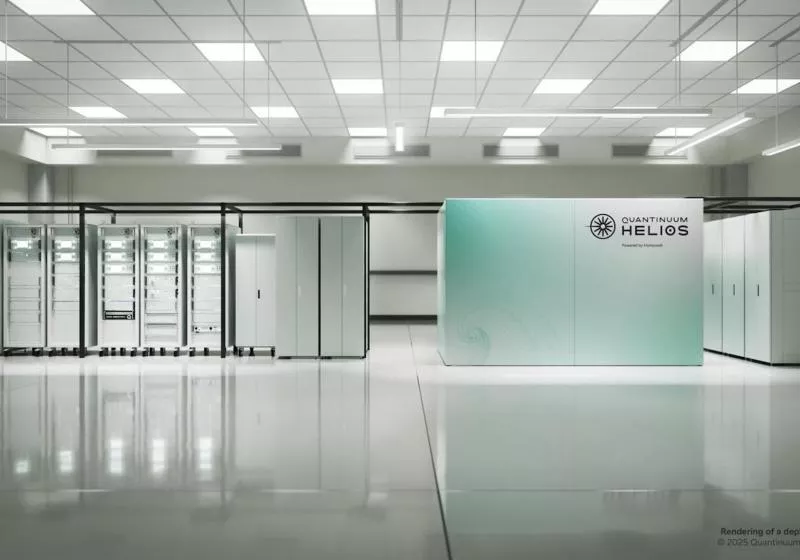
Quantinuum, a quantum computing firm based in Cambridge, UK and Broomfield, Colorado, has unveiled its latest 98-qubit quantum computer, Helios. This new processor represents a significant engineering advancement in trapped-ion quantum computing, designed to address the growing complexity of managing qubits as systems expand. The Helios processor employs a four-way junction to route ions between memory and processing areas, along with a sophisticated control system that coordinates these movements while overseeing quantum operations.
This integrated approach allows Helios to execute operations in parallel more efficiently than previous trapped-ion designs. Helios is the largest trapped-ion quantum computer demonstrated to date, surpassing Quantinuum's previous models with 32 qubits in 2023 and 56 qubits in 2025. The processor utilizes charged atoms, or ions, as qubits, with electromagnetic fields maintaining the ions above the chip surface.
Laser pulses facilitate the execution of quantum gates. Helios adheres to the quantum charge-coupled device (QCCD) design, which differs from earlier QCCD models that confined all qubits in a fixed location. In Helios, ions are stored in one part of the machine and transported to various areas for processing. The device's layout includes a ring-shaped memory region connected to two processing paths, with the four-way X junction at their intersection.
This physical design provides the system with a greater array of potential routes and enables it to handle multiple tasks concurrently. The Helios runtime software plays a crucial role in organizing the processor's workload. This software dictates when ions should relocate, their destinations, and the timing of laser operations.
It must circumvent routing conflicts while ensuring the quantum circuit operates efficiently. Unlike superconducting quantum computers, where qubits are generally fixed and controlled by electrical signals, Helios' trapped-ion QCCD system treats moving qubits as integral to the calculation. This approach aims to minimize crosstalk, where operations on one qubit interfere with others, and allows for qubit measurement and resetting during computation to detect and correct errors before they propagate.
The ability to move ions through the device also facilitates the convergence of distant qubits for operations. While Helios has demonstrated calculations that classical methods cannot replicate within practical time and power limits, it is essential to note that these tests involved random benchmark tests, not scientific or commercial applications.
The processor does not yet prove that quantum computing can solve useful business or research problems more efficiently than classical computers. Furthermore, Helios is far from achieving fault-tolerant quantum computing, a milestone generally anticipated to require around a million qubits. The UK National Quantum Strategy has set a target for a fault-tolerant computer capable of performing one trillion operations.
To scale the technology, linking multiple QCCD devices through quantum connections would be necessary. However, this would introduce new challenges, such as potential traffic bottlenecks for ions as they navigate the system, and the need for extremely precise voltage controls across a larger machine. While Helios represents a significant breakthrough in the hardware and control systems required for scaling trapped-ion processors, it is not a practical fault-tolerant quantum computer.
Written by urgent.news from TechSpot's reporting — not their text. Machine-written — may contain errors; check the original before relying on it.