The bubbling surface of doomed supergiant star Betelgeuse has been revealed like never before
Betelgeuse may be a well-known and often-studied stellar object, but that doesn't mean astronomers aren't capable of capturing this doomed star in a completely new light.
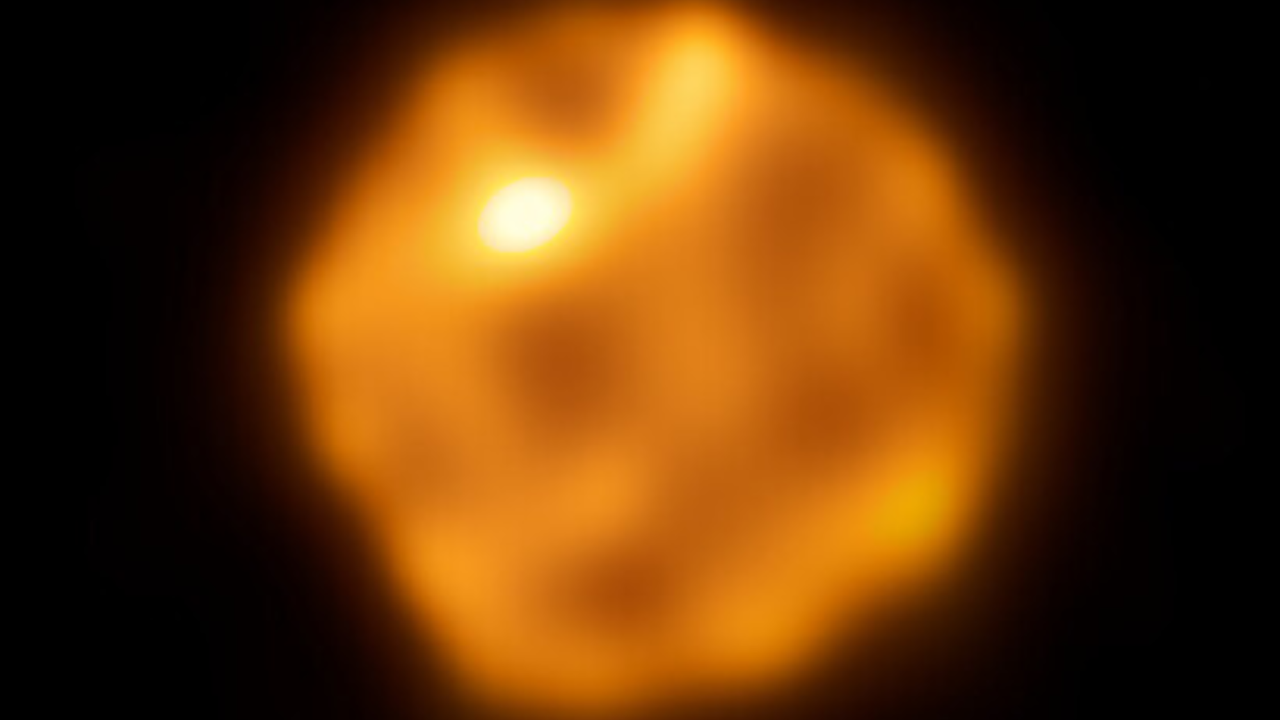
Betelgeuse, a red supergiant star located about 600 light-years away from Earth, has captured astronomers' attention due to its turbulent surface. This star, 20 times more massive than our sun, has been the subject of intense scientific scrutiny, particularly after a rapid and dramatic dimming in recent years led some scientists to hypothesize that it was about to explode in a supernova. However, the star has defied expectations and remains a focal point of study.
Utilizing the Atacama Large Millimeter/submillimeter Array (ALMA), a team of scientists captured highly detailed images of Betelgeuse in 2023, revealing bright hotspots on its surface and an almost corrugated texture. These images showcase the star's complex structure, with a temperature of around 3,680 degrees Fahrenheit (2,030 degrees Celsius) and regions even hotter than the surrounding plasma. One such region is 980 degrees Fahrenheit (530 degrees Celsius) hotter than its immediate surroundings.
The uneven nature of Betelgeuse's surface is attributed to massive convective movements, where hot plasma rises through the star and generates shockwaves that erupt in its atmosphere, creating bright and hot regions. A noteworthy observation is the persistence of a hotspot in the northeast of the stellar disk for at least seven years, which is longer than predicted by current stellar models. This longevity challenges existing theories and suggests a more complex stellar atmosphere than previously thought.
Interestingly, the orientation of these hotspots also supports the possibility that Betelgeuse may be orbited by an unseen companion star. Researchers will continue to monitor Betelgeuse with ALMA to track the stability of these hotspots and their evolution in relation to the star's mass loss and atmospheric structure. This ongoing investigation is expected to persist until Betelgeuse eventually explodes in a supernova, marking the end of its life cycle.
The team's findings have been accepted for publication in the journal Astronomy & Astrophysics and are available on the arXiv repository site.
Written by urgent.news from Space.com's reporting — not their text. Machine-written — may contain errors; check the original before relying on it.