pyATS vs Ansible: Choosing the Right Tool for Network Automation
Should you learn pyATS or Ansible first? Learn how both tools work, where they differ, and why network engineers ultimately need both.
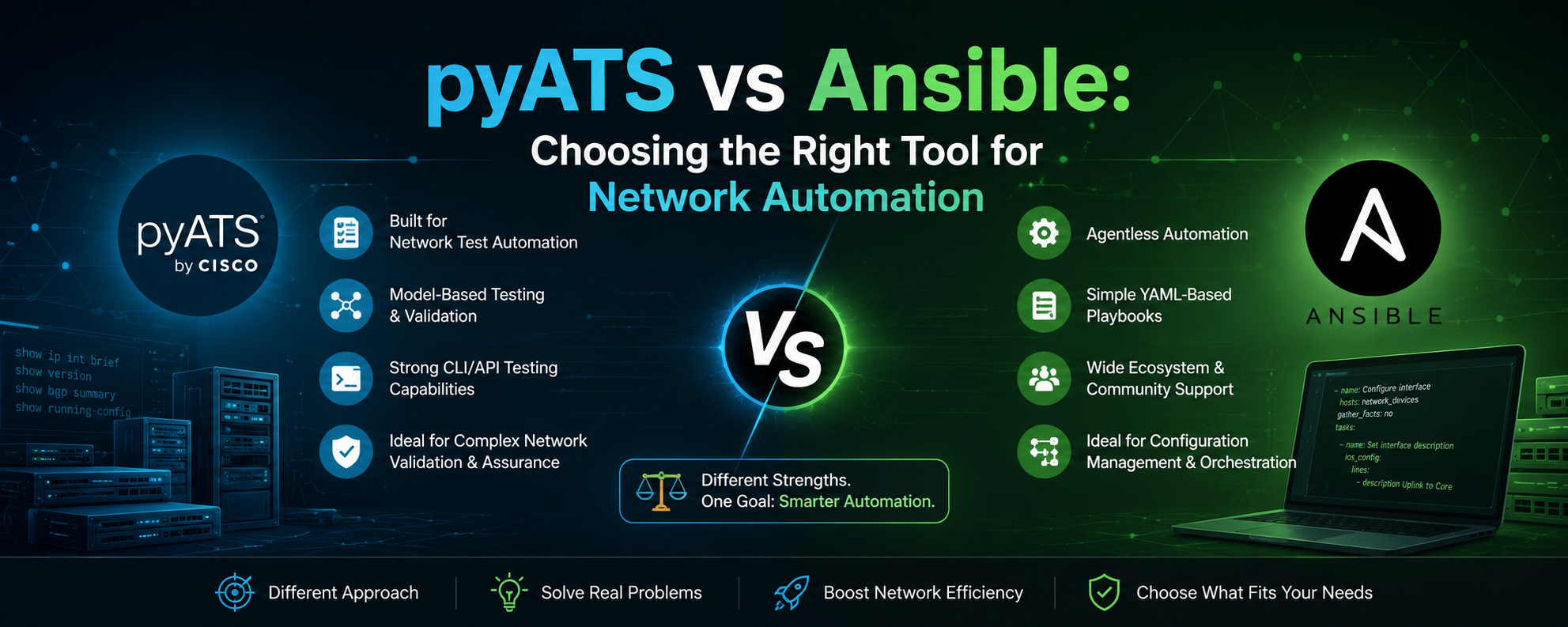
When it comes to choosing between pyATS and Ansible for network automation, the key is to understand that they serve completely different purposes. Ansible is an executor, responsible for configuration management and deployment. You write a playbook describing the desired state of your network, and Ansible makes those changes on the actual devices. On the other hand, pyATS is a validator, designed to check the current state of your network and compare it to the expected state after changes have been made.
Ansible and pyATS solve completely different problems, and if you have experience in a live production environment, you'll soon realize why both tools are essential. Ansible's configuration management and deployment capabilities are powerful, but they don't validate whether the changes have been made correctly or if the network is functioning as expected. PyATS, on the other hand, excels at validation, allowing you to compare the pre and post-state of your network and flag any differences.
While pyATS is vendor-agnostic in theory, it is a Cisco-first tool in practice due to limited parser coverage for other vendors. If you're working in a multi-vendor environment, you may need to write custom parsers or rely more on Ansible's broader vendor module support.
The learning curve for Ansible is relatively low, as it uses YAML, a simple syntax that is easy for network engineers to grasp. Ansible is great for making quick changes to production devices, but it does have a blast radius, meaning that if something goes wrong, the impact can be significant. PyATS, on the other hand, has effectively zero blast radius since it doesn't make any changes to the network. It simply connects, captures states, compares them, and reports the results.
To get started with pyATS, you'll need to learn some basic Python concepts. While you don't need to be an expert, understanding dictionaries, nested data structures, loops, conditional statements, and basic object-oriented programming will be helpful. This learning journey can be challenging, especially if you have no prior Python experience, but it's worth the effort.
Many network engineers find that they can build their test cases and complete their first YAML test file quickly, but the real learning happens when they start writing Python to parse the output and validate the network state.
Written by urgent.news from HackerNoon's reporting — not their text. Machine-written — may contain errors; check the original before relying on it.