Cutting-edge infrared space telescope Roman set to launch
The NASA-led Nancy Grace Roman Space Telescope is set to launch on 30 August 2026 at 07:26 EDT / 12:26 BST / 13:26 CEST from NASA’s Kennedy Space Center in Florida, USA. With its wide field of view and advanced optical design, the Roman telescope will conduct detailed scans of the sky in visible to near-infrared light. In doing so, Roman will help reveal the nature of dark energy and dark matter…
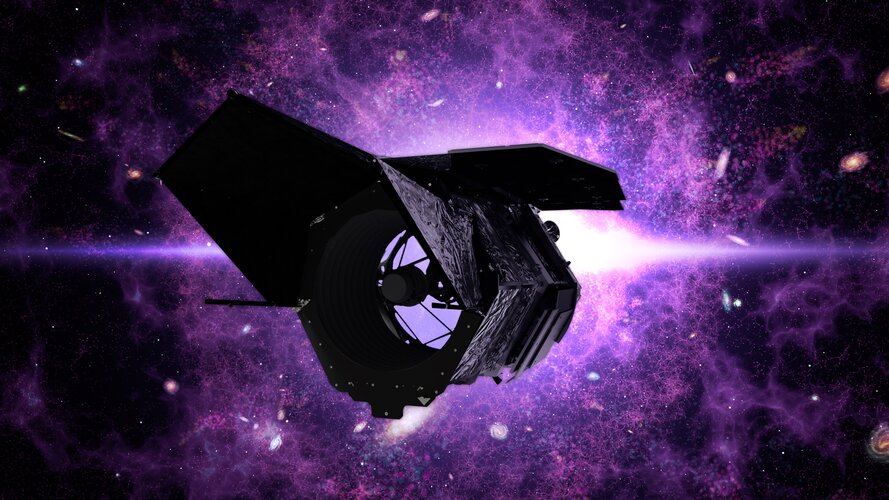
NASA's Nancy Grace Roman Space Telescope is on track to launch on August 30th, 2026, from Kennedy Space Center in Florida, according to the latest updates. This state-of-the-art telescope, led by NASA, will capture the sky in visible and near-infrared light, offering a panoramic view over 200 times larger than that of the Hubble Space Telescope.
The Roman telescope, developed with contributions from the European Space Agency (ESA), will play a crucial role in unraveling the mysteries of dark energy and dark matter. ESA is lending essential hardware, including star trackers, batteries, detectors for the coronagraph instrument, and communications support.
One of the telescope's primary objectives is to map the distribution of ordinary and dark matter throughout the history of the Universe. By studying the slight distortions in distant galaxies caused by the presence of dark matter – a phenomenon known as weak gravitational lensing – Roman will help astronomers create a detailed map of this mysterious substance.
The Roman Space Telescope will also investigate the Universe's expansion, which appears to be accelerating. Scientists believe dark energy, comprising about 70% of the Universe, is driving this phenomenon. Roman will use multiple methods to study dark energy, such as observing supernovas and galaxies' clustering patterns.
In addition to its scientific goals, the Roman telescope will also focus on discovering exoplanets, including those similar to Earth. Its wide field of view will allow it to detect thousands of exoplanets by observing the slight dimming of light from stars when planets pass in front of them. The telescope's advanced coronagraph instrument will even enable the direct imaging of these exoplanets, providing unprecedented detail.
Moreover, Roman will investigate extreme cosmic events, such as the birth of black holes and tidal disruption events, as well as active galaxies hosting quasars from the early Universe. With its unparalleled combination of depth, area, and image quality, the Roman Space Telescope has the potential to make groundbreaking discoveries and surprise astronomers with unexpected findings.
Written by urgent.news from ESA Space Science's reporting — not their text. Machine-written — may contain errors; check the original before relying on it.
This story
This is one outlet's version. Read the fullest account.