Consumers Make Budgets Work by Doing More Than Cutting Back
Households squeezed by higher prices are getting better results when they treat budgeting like a toolbox, not a single pair of scissors. A new PYMNTS Intelligence data book, “Five Ways Consumers Make Tight Budgets Work Harder,” finds that consumers are combining small changes to protect essential spending. They’re trimming selected extras, buying store brands, checking prices from store aisles…
Households facing higher prices are improving their budgeting outcomes by treating budgeting more like a toolbox than a single solution. A PYMNTS Intelligence data book titled “Five Ways Consumers Make Tight Budgets Work Harder” reveals that consumers are combining minor adjustments to safeguard essential spending. They trim non-essential extras, opt for store brands, compare prices, and shift grocery spending to value retailers.
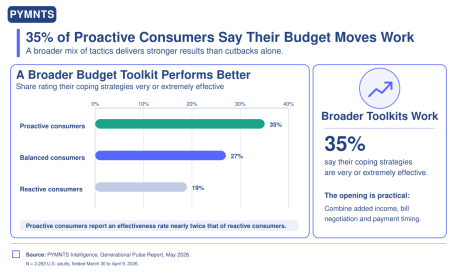
Some also increase income, negotiate bills, and modify payment schedules. The most promising finding is that consumers employing multiple strategies report greater success compared to those relying solely on spending cuts. A broader approach yields stronger results. Thirty-five percent of proactive consumers rated their coping strategies as very or extremely effective, compared to 27% of balanced consumers and 19% of reactive consumers.
Proactive households are more likely to combine income boosts, bill negotiations, and payment timing adjustments. While higher costs cannot be eliminated, this approach can give families greater control over when money arrives and leaves. Paycheck-to-paycheck consumers, who struggle to pay bills, spent 53% less on nonessential items like dining out, entertainment, and travel during the past year, nearly double the 27% among financially stable consumers.
Another 24% of financially strained consumers maintained nonessential spending levels, while 23% increased it. These figures suggest many households are preserving some discretionary spending rather than cutting it entirely. Everyday shopping tools are working harder than ever. Nearly half of Labor Economy consumers, or 49%, purchased store-brand or private-label products in the past year.
Store brands outperformed coupons and promotional codes, which were used by 46% of consumers. Smartphones also aided shoppers, with 35% utilizing mobile assistance to search for discounts and 26% comparing prices at various merchants. Consumers' shopping habits also reflect financial stress. Among online grocery shoppers with high financial strain, 56% made their most recent purchase from Walmart, compared to 50% of those with low stress.
The in-store difference was even wider, at 37% versus 26%. These changes won't eliminate the strain caused by higher prices. However, the findings demonstrate that consumers possess more tools to manage expenses than simply cutting costs. Small adjustments can work together to create more breathing room while maintaining essential bills.
At PYMNTS Intelligence, we partner with businesses to uncover insights that empower intelligent, data-driven discussions on evolving customer expectations, a more interconnected economy, and strategic shifts needed for success. With rigorous research methods and a dedication to objective quality, we provide reliable data to help your business grow.
Written by urgent.news from PYMNTS's reporting — not their text. Machine-written — may contain errors; check the original before relying on it.