Bundesregierung: Wirtschaft, Klima, Drohnen: Kabinett versucht den Neustart
Mit seiner Kabinettsumbildung hat der Kanzler vor der Sommerpause für Turbulenzen gesorgt. Nun versucht die neue Regierung bei ihrer Klausur, die Stimmung vor schwierigen Wahlen wieder zu heben.
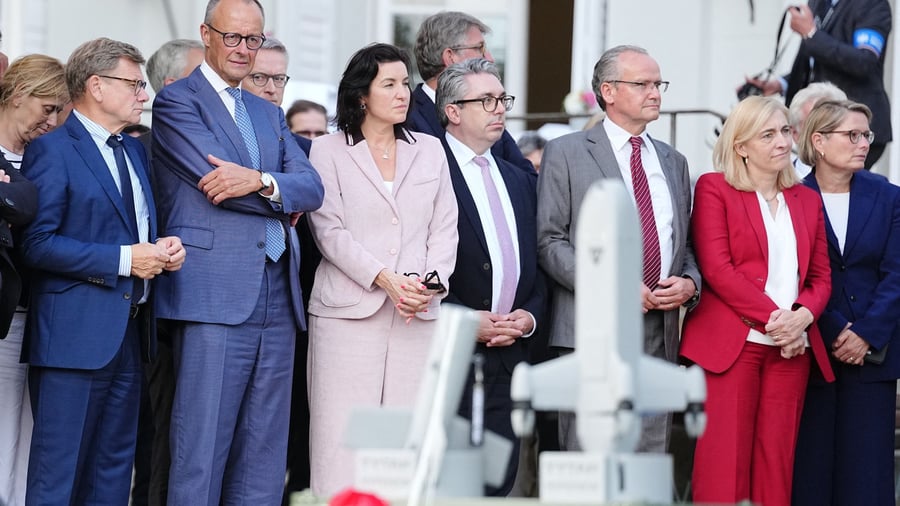
Bundeskanzler Friedrich Merz (CDU) announced concrete outcomes from the heat wave and drought this summer during the opening of the cabinet's meeting at Schloss Neuhardenberg in Brandenburg. The responsible ministers would first assess the current situation on Wednesday, said the CDU leader. "We will then draw the conclusions for the next cabinet sessions with concrete decisions."
Merz expressed confidence that the downturn of the German economy would soon be overcome. "Our country has great potentials and there is absolutely no reason to keep us down." He also announced that the cause of the explosive drone incident at Leipzig Airport would be revealed "soon." In line with this, Munich-based Tytan Technologies provided Merz and his cabinet with fast intercepting drones capable of destroying drones flying at speeds of up to 400 kilometers per hour at a height of up to five kilometers.
These drones are intended for future use in Ukraine. Reshuffle: Changes in several posts Merz reshuffled his cabinet in July following the resignation of Union faction leader Jens Spahn and made changes to several positions. Former Health Minister Nina Warken (CDU) is now the Chancellor's office head. Her ministry was taken over by previous CDU General Secretary Carsten Linnemann.
Former Union parliamentary business manager Steffen Bilger has been replaced by Patrick Schnieder (CDU) as Transport Minister. And Phlipp Amthor is now the State Minister Bund-Länder-Koordinator in the Chancellor's office. The replacement of Schnieder particularly caused resentment within the CDU, which still lingers. Vice Chancellor Lars Klingbeil and Labor Minister Bärbel Bas (SPD) are under heavy pressure in their own ranks due to low poll numbers of around 12 percent.
New atmosphere: Merz calls for "good atmosphere" The cabinet's meeting was to now lift the mood in the black-red coalition, which is about two weeks before the important state election in Saxony-Anhalt, followed by two more elections in Berlin and Mecklenburg-Western Pomerania. "Take the good weather and the pleasant temperatures as evidence that we are in a good atmosphere here in Neuhardenberg in the cabinet," said Merz upon arrival under clear blue skies.
Bas said: "My mood is good." And the mood of the government? "It will get even better." New atmosphere: Neuhardenberg instead of Villa Borsig The good mood was also to contribute to the new venue of the cabinet's meeting. The first coalition meeting of Black-Red in the last autumn still took place in Villa Borsig on the Tegeler Lake on the outskirts of Berlin.
This venue, however, since a run-away session of the coalition committee in April 2026, has become the symbol of conflict between Union and SPD. A new venue was therefore needed. The Neuhardenberg castle built in the style of Prussian classicism, situated east of Berlin with a large garden area, today is a hotel with 54 rooms, where political meetings have already taken place several times - including two cabinet meetings of the black-red government of Chancellor Gerhard Schröder (SPD) in 2003 and 2004.
New reforms: Merz wants to push pace Merz wants to bring the black-red cabinet in Neuhardenberg at a brisk pace with reform projects: "We want to get out of the growth weakness of our economy," he said at the meeting opening. "We want to give our economy new impetus and job creation." Germany largely has this in hand, Merz said.
But the state must create the necessary and right conditions. The decision on the summer break is still pending. The three East German CDU ministers Sven Schulze (Saxony-Anhalt), Michael Kretschmer (Saxony) and Mario Voigt (Thuringia) have jointly opposed plans to abolish the flat-rate pension after 45 years of contributions, known as the pension of 63, which is called the pension with 63.
Chancellor Merz and his Labor Minister, however, have decided to consider the reform as a "total artwork" that cannot be changed. The decision on this will be made in the autumn. New conflict topic: Consequences of the heat wave The SPD ministers at the meeting brought a new topic with potential for conflict, calling for a strengthening of climate protection through a constitutional amendment as a lesson from the heat wave.
The Union is skeptical to doubtful about the plan. Merz signaled his readiness to act, at least below the constitutional amendment, at the cabinet meeting opening. "Drought, heat, forest fires and falling harvests show us that concrete action needs to be taken," said the Chancellor. There hardly was a life area that was not affected.
"For the federal government, it is therefore clear: We must further curb climate change and at the same time better adapt our country to the consequences of climate change." New dimension of threat: Leipzig drone attack Merz also provided clarity on another topic that has been hot in the summer. The background of the "Leipzig attack" involving an explosive drone would be revealed "soon."
More concretely, Merz did not yet say. But it sounded as if the federal government already had a fairly concrete picture of the perpetrators and did not want to wait for it to leak through other channels. Experts suspect state Russian entities to be responsible for the incident. Leipzig shows that Germany is "plainly threatened," Merz said. He made clear that the attackers had to expect a reaction. "They will pay for it."
Written by urgent.news from Handelsblatt's reporting — not their text. Machine-written — may contain errors; check the original before relying on it.