Apple built its new M6 and M5 Ultra desktops for the people daisy-chaining Macs to run AI
The new M6 chip moves to TSMC's 2nm process and is the first Apple SoC to combine all three core types at once. The CPU has 12 cores: two "super cores," four performance cores, and six efficiency cores. Super cores themselves aren't new. Apple introduced them with the M5 Pro... Read Entire Article
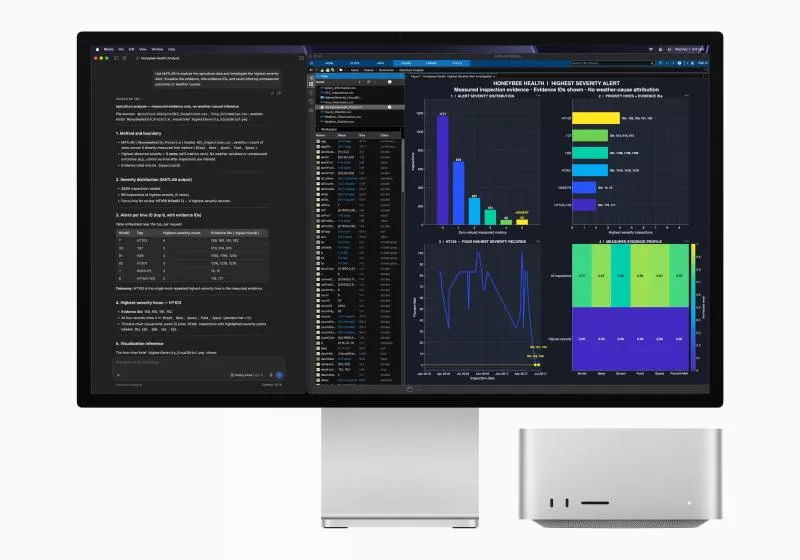
Apple unveiled two new chips and two upgraded desktop computers today. The M6 chip marks Apple's debut in 2nm technology, while the M5 Ultra boasts a quad-die design and represents the company's most powerful silicon to date. The desktops themselves do not feature substantial new features, but they carry significant price and specification enhancements.
The changes in recent years revolve around who these machines cater to and whether consumers can acquire them. The M6 chip transitions to TSMC's 2nm process and is the first Apple System-on-Chip to integrate all three core types simultaneously. It boasts 12 cores: two super cores, four performance cores, and six efficiency cores.
Apple asserts the M6 achieves the world's fastest single-threaded performance, 1.2 times the multithreaded throughput of the M5, and a 40% improvement in CPU performance over the M4. The GPU transitions to 12 cores, paired with a Neural Accelerator in each one, delivering nearly 30% more peak GPU compute for AI compared to the M5.
Additionally, the chip includes a dual 16-core Neural Engine that can be accessed concurrently by system frameworks, storage with twice the speed (15GB/s), and up to 170GB/s of memory bandwidth. Memory capacity is capped at 32GB, which holds more significance than it may initially appear. The Ultra model stands out as the more intriguing chip.
Apple's UltraFusion interconnect fuses two dual-die M5 Max chips into a singular quad-die package, offering inter-die bandwidth exceeding 4.4TB/s and more than 6 times the connection density of the previous version. This configuration yields up to 36 CPU cores (12 super, 24 performance), up to 80 GPU cores, a 32-core Neural Engine, and up to 512GB of unified memory running at 1.2TB/s.
Apple claims a 4.5 times increase in peak GPU compute for AI compared to the M3 Ultra and a 40% enhancement in graphics performance. The cheaper Mac receives the latest process node, while the flagship chip retains the M5's 3nm process. Although this may seem counterintuitive, it implies that the M5 Ultra represents a more substantial leap than the M6 in AI workloads.
We have previously reported that Apple does not plan to introduce M6 Pro or M6 Max, advancing directly to the M7 in mid-2027. Apple released macOS 26.2 last December, introducing support for low-latency communication between Thunderbolt 5 hosts, specifically tailored for distributed inference using MLX. Since then, enthusiasts and developers have been linking Mac minis and Mac Studios to run models far larger than any single consumer machine could handle, serving as an alternative to purchasing multiple Nvidia hardware units.
The Mac Studio now officially supports clustering over Thunderbolt 5 with Remote Direct Memory Access (RDMA), enabling memory pooling across systems. Apple claims that four clustered Studios can achieve up to 3 times the inference throughput of a single machine. A new Core AI framework accompanies MLX. The Studio is positioned as the ultimate desktop for on-device AI, while the mini functions as an always-on agentic machine.
Currently, the economics of this approach are straightforward. Developers are deploying cloud coding agents while monitoring mounting token bills, and open-weight models like Qwen and DeepSeek can handle a significant portion of the same work on local hardware. However, standard consumer machines still lack the capability to hold models large enough to replace a frontier API, which explains why individuals began chaining Macs together in the first place.
This shift is noteworthy for a product that was previously considered an afterthought in Apple's Mac lineup. The mini accounts for approximately 3% of Mac unit sales in the US, as reported by Consumer Intelligence Research. The M6 mini starts at $899, while the M5 Pro mini is priced at $1,699, both $100 higher than the current M4 and M4 Pro models.
The Mac Studio begins at $2,499 with the M5 Max, equivalent to the current M4 Max model, and $5,499 with the M5 Ultra, a $200 increase from the M3 Ultra model. These comparisons appear favorable for Apple, yet this is due to the baseline having already been raised. The M4 mini launched at $599 in October 2024. Apple discontinued that configuration in May, raising Mac prices by roughly 15% to 20% in late June, stating that these increases were necessary due to component costs.
Consequently, the most affordable way to enter Apple's desktop lineup is up 50% over the past two months, and it comes with 16GB of memory and a 256GB SSD. Upgrades are prohibitively expensive. An additional 8GB costs $200. Reaching the M6's 32GB limit incurs an additional $400. A fully upgraded Mac Studio exceeds $15,000. This trend is not exclusive to Apple; DRAM pricing surged approximately 90% quarter-over-quarter in Q1 2026 and another 50% or more in Q2.
IDC describes this as a "structural reallocation of wafer capacity" rather than a typical cycle, as every wafer dedicated to AI HBM becomes unavailable for regular RAM in laptops. Consequently, companies like Microsoft, Asus, MSI, Nintendo, Sony, and Valve have raised hardware prices this year. Demand has already outpaced supply for the outgoing Mac mini and Studio, with some configurations experiencing weeks or months of waiting periods.
Apple removed its largest memory options early in 2026 and has struggled to maintain stock for certain MacBook models. The new mini and Studio now reach memory capacities of up to 512GB, but these configurations become available in late October. All other models launch on September 22, with pre-orders starting at that time. Apple recently showcased a Mac mini assembly line in Houston, set to commence production later in the year.
The company emphasizes that a higher initial hardware cost may prove more cost-effective than ongoing AI service fees, but this only holds true if consumers can actually purchase the hardware. Performance claims made by Apple are based on their own assessments, using the standard "up to" phrasing and benchmarks against different baselines, such as M1, M4, and M3 Ultra.
One additional context is that Tim Cook recently addressed the company's financial performance and strategic direction.
Written by urgent.news from TechSpot's reporting — not their text. Machine-written — may contain errors; check the original before relying on it.
This story
This is one outlet's version. Read the fullest account.
- Apple launches M6 Mac mini and M5 Ultra Mac Studio in major AI upgrade gulfnews.com
- Apple unveils M6 and M5 Ultra chips with more horsepower and AI compute digitaltrends.com
- Apple's M5 Ultra is its most powerful chip ever - with 4x faster AI performance than M3 Ultra zdnet.com
- Apple introduces M6 and M5 Ultra with faster performance and AI compute arabianbusiness.com
- Apple launches M5 Ultra and M6 chips for Macs techinasia.com
- Apple introduces M6 and M5 Ultra for a big leap in performance and AI compute apple.com