Workers in China worry over being replaced as they adapt to the growing impact of AI on jobs
Artificial intelligence is beginning to reshape China's job market, supported by state policies that some economists believe might undermine the overall strength of its economy.
Workers in China are growing concerned about potential job displacement as artificial intelligence (AI) continues to gain traction across various industries. In a recent instance, computer programmer Fei Zhaojun was laid off along with 160 of his colleagues after his boss questioned the feasibility of AI replacing human coders. This situation is emblematic of a broader trend as AI adoption is accelerating in China, driven by government policies that encourage its use in all facets of life.
Economists warn that this rapid integration of AI could weaken the strength of China's economy, the second-largest in the world. As Chinese businesses and individuals increasingly adopt AI applications, many workers are left uncertain about their future roles. Beijing-based senior analyst Shujing He notes that while there is no widespread anti-AI sentiment in China, many people are both intrigued and cautious about the technology's impact on employment.
Fei Zhaojun, who was once skeptical about AI's capabilities in programming, has now embraced it as a means to adapt during a career break. He is creating vlog-style videos about ordinary people's lives, hoping to share his insights. Meanwhile, Du Qinchun, a part-time translator, is leveraging AI to aid in his translation work, though he acknowledges that the pay in his industry has been significantly cut. This shift has caused a decline in popularity for college programs focusing on foreign languages.
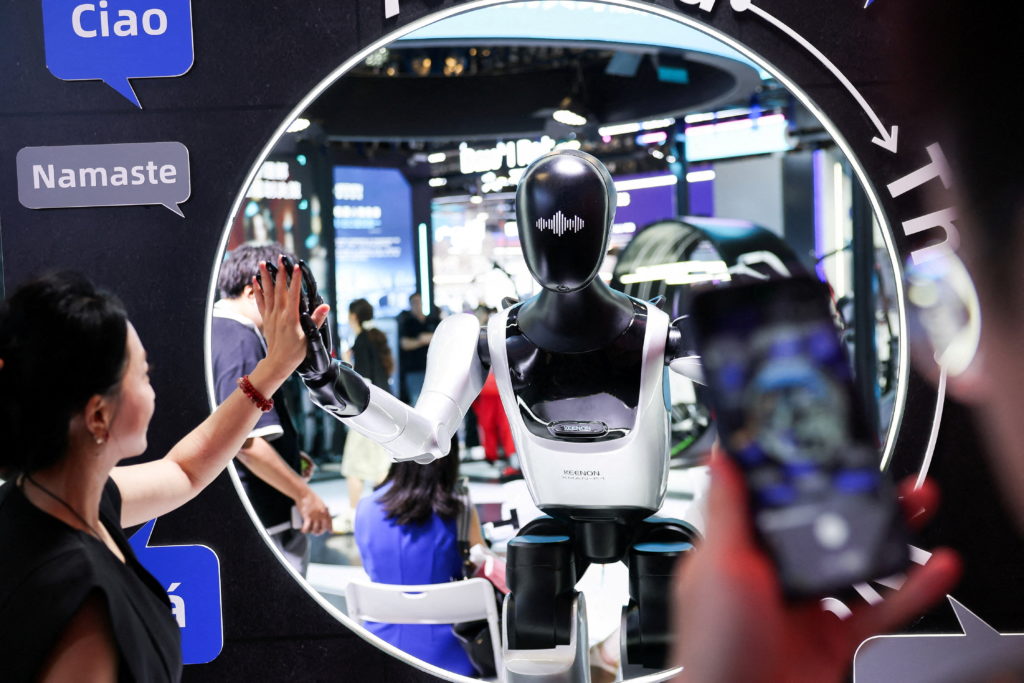
The adoption of AI-powered tools and robots in various sectors is on the rise, threatening the livelihoods of workers in roles that can be easily automated. From parcel sorting to traffic directing and even food delivery, AI is increasingly taking on tasks that once required specialized training. This trend is particularly evident in China's burgeoning short drama industry, where the use of generative AI has led to a 75% decline in live-action short and vertical video series over the past year.
Despite the potential benefits of AI, such as increased productivity, concerns are mounting about its disruptive effects on employment and social stability. A report from the International Labour Organisation (ILO) found that women are at a higher risk of job loss due to AI adoption, as they tend to work in sectors more susceptible to automation, such as electronics assembly, and are underrepresented in science and technology.
China's government aims to leverage AI to gain a technological edge in its rivalry with the United States, as outlined in the "AI Plus" initiative and its five-year plan through 2030. However, the economic outlook remains uncertain, with China's urban unemployment rate hovering around 5%, and youth unemployment (excluding students) being around 5%. The government's push for AI integration could lead to severe job disruption and potentially undermine social stability in the country.
Written by urgent.news from Gulf News's reporting — not their text. Machine-written — may contain errors; check the original before relying on it.
This story
This is one outlet's version. Read the fullest account.
- Workers in China worry over being replaced as they adapt to the growing impact of AI on jobs apnews.com
- Workers in China worry over being replaced as they adapt to the growing impact of AI on jobs economictimes.indiatimes.com
- Workers in China worry over being replaced as they adapt to the growing impact of AI on jobs mainichi.jp
- Workers in China worry over being replaced as they adapt to the growing impact of AI on jobs winnipegfreepress.com
- Workers in China worry over being replaced as they adapt to the growing impact of AI on jobs gulfnews.com