The Solar System Nearly Had 12 Planets Before Pluto Was Demoted
Learn how Pluto nearly kept its planet status in a proposed 12-planet Solar System as its demotion marks its 20th anniversary.
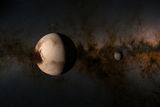
In August 2006, the International Astronomical Union (IAU) was on the verge of expanding the Solar System's planetary count to 12. Pluto would have remained a planet, joined by Ceres, Charon, and 2003 UB313 (later named Eris). However, just eight days prior, the IAU altered the definition of a planet, leaving the Solar System with eight planets and Pluto classified as a dwarf planet. Twenty years later, scientists still debate the criteria for planet classification.
According to IAU, Eris was similar in size to Pluto, and if it qualified as a planet, other distant worlds might also be considered planets. However, if it did not, Pluto's case had to be explained. The IAU spent nearly two years debating the definition, with chair Owen Gingerich recalling members struggling to reach an agreement.
The final IAU draft focused on a body's physical properties – it needed to orbit a star, have enough mass for its gravity to pull it into a nearly round shape, and clear its orbital neighborhood. Under these requirements, Pluto, Ceres, Charon, and Eris all qualified, with Pluto and similar outer Solar System worlds classified as "plutons."
The definition that became official required a planet to orbit the sun, be nearly round, and clear its orbital neighborhood. Pluto, having cleared its orbit, met the first two requirements but failed the third as it shared space with thousands of icy bodies in the Kuiper Belt. The main definition passed with a "great majority," while a separate resolution designating Pluto as a dwarf planet received 237 votes in favor, 157 against, and 17 abstentions.
Despite the reclassification, some planetary scientists argue for classifying planets based on their internal makeup and geological behavior, including Pluto and other large moons. Others still favor orbital dominance as the primary criterion. The debate continues, with researchers proposing measurable definitions that could apply to planets beyond the Solar System. Ultimately, the discussion revolves around what defines a planet: its physical characteristics or its gravitational influence on its surroundings.
Written by urgent.news from Discover Magazine's reporting — not their text. Machine-written — may contain errors; check the original before relying on it.