Sandisk's huge new SSDs are set up specifically for NAS devices, with the largest offering a frankly ridiculous 7.68TB
Sandisk introduces NAS-focused SSDs spanning 500GB to 7.68TB, combining SATA and PCIe 5.0 interfaces with high endurance ratings.
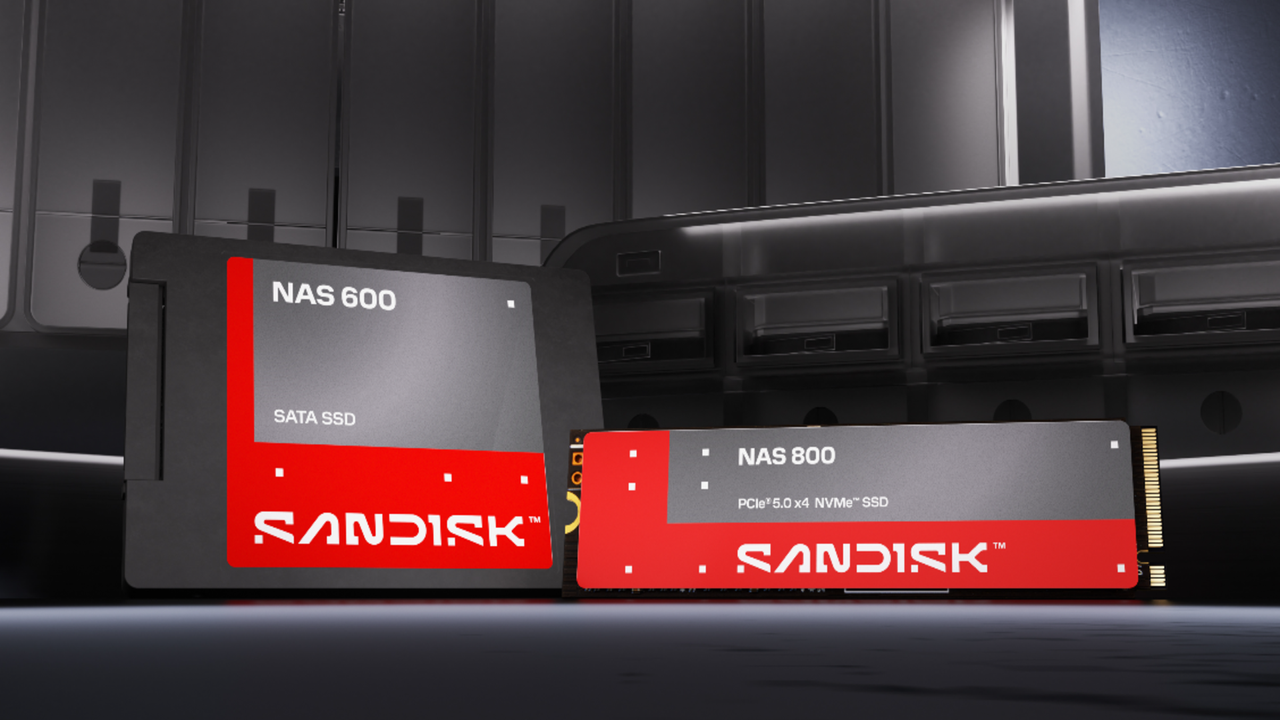
Sandisk has launched a new line of SSDs specifically designed for network-attached storage (NAS) systems, with the largest drive offering an impressive 7.68TB of storage capacity. The flagship NAS 800 drive features a PCIe 5.0 interface and supports capacities up to 7.68TB, while the NAS 600 drive is available in SATA 2.5-inch form factor with capacities ranging from 500GB to 4TB.
Both drives are targeted towards prosumers, creative professionals, and small businesses, offering high-performance storage solutions for continuous use in multi-user environments.
The NAS 600 features a 2.5-inch, 7mm SATA design with sequential read speeds up to 560 MB/s and endurance ratings ranging from 350 TBW to 2,500 TBW, depending on the model. In comparison, the NAS 800 uses an M.2 2280 form factor with PCIe 5.0 connectivity, providing sequential read speeds up to 14,900 MB/s and random read/write speeds up to 2.3M IOPS and 2M IOPS, respectively.
Sandisk rates the 7.68TB NAS 800 at 14 PBW (petabytes written) endurance, which is roughly equivalent to 14,000 TBW, or about 7.67 TB of writes per day over five years.
Priced at $179.99 for the 500GB model, $279.99 for 1TB, $499.99 for 2TB, and $999.99 for 4TB, the NAS 600 lineup is aimed at those looking for an accessible upgrade path from traditional hard drives, with support for solid-state caching and storage tiering. The NAS 800 series, starting at $309.99 for 960GB, can go up to $2,199.99 for the 7.68TB flagship model, which is considerably more expensive than consumer-oriented SSDs with similar storage capacities.
These high-end drives will be available starting September via Sandisk's official website and select e-commerce platforms worldwide.
Written by urgent.news from TechRadar's reporting — not their text. Machine-written — may contain errors; check the original before relying on it.