Auto-Industrie: Krise und große Sorgen - Was ist bei VW los?
„Mehr als kritisch“ - so beschreibt Oliver Blume die Lage bei Volkswagen. Der Konzernchef will den Sparkurs verschärfen. Ein Abbau von Zehntausenden Jobs wird befürchtet. Turbulente Tage stehen bevor.
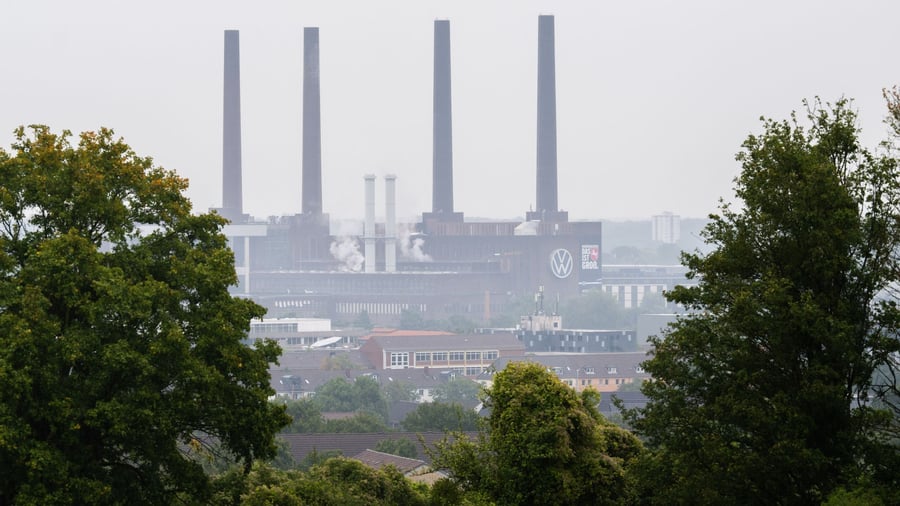
Volkswagen is facing a severe crisis with nine extraordinary business assemblies set to take place in the coming days. The company's leadership aims to reduce costs and improve competitiveness, while employees, unions, and politicians are worried about tens of thousands of jobs and the future of sites in Emden, Hannover, Zwickau, and Neckarsulm.
In an interview, VW CEO Oliver Blume described the situation as "more than critical," stating that VW earns too little to finance its future. Previous savings were insufficient, and the company is "overdimensioned," making it slow and complicated. Blume highlighted the broader crisis in the automotive industry, including US tariffs, the decline of the Chinese market, geopolitical conflicts, increased competition in Europe, and strict regulations.
He announced a new "2030 target plan" and increased austerity measures. Nine Betriebsversammlungen (employee meetings) are planned, including events in Hannover, Braunschweig, Salzgitter, Dresden, Chemnitz, and Kassel-Baunatal, with the first on August 25th in Wolfsburg. Blume and VW's marketing chief, Thomas Schäfer, will speak to the workforce together at the opening assembly in Wolfsburg on August 27th.
The two will also speak at the Zwickau and Emden sites, both of which may be in jeopardy. German state premier Olaf Lies (SPD) plans to visit the Hannover plant on Monday. Blume urged unity within the workforce, stating, "Everyone must pull together. We have established the largest transformation plan in the history of the Volkswagen Group."
The next years are crucial, "who stays in the race and who gets to the top." The fear of factory closures is widespread among employees. Blume noted that no competitive workforce composition can be presented for Emden, Hannover, Zwickau, and Neckarsulm in the 2030s. "We also need to cut more than 500,000 vehicles per year in Europe."
However, "a decision on concrete plant closures has not been made. Plant closures are always the most expensive and last resort. If, despite all efforts, it turns out that a successor location is not possible, the goal is to create new perspectives." The exact number of job cuts remains unclear, but massive reductions are expected.
VW CEO Blume mentioned that there is agreement since the end of 2024 to cut around 50,000 positions in Germany by 2030 - socially acceptable, voluntary, and primarily through phase-out. However, the frequently cited figure of about 50,000 worldwide positions is not a fixed target. It is calculated based on the cost goal compared to competitors and provides an orientation for the extent of the company's action need.
The Betriebsrat, IG Metall, and the Lower Saxony government, as well as mayors of VW sites, have a united stance, all demanding the management to quickly clarify the situation. Drastic steps like plant closures must be avoided at all costs. Lower Saxony's premier, Lies, stated that all shareholders and the management must pursue the goal of stabilizing industrial locations in Germany and Lower Saxony.
He expects Volkswagen to explore other growth fields if automotive production at a location cannot continue. "Nothing else is acceptable." Lies mentioned sectors like defense, humanoid robots, and drones, and that China-developed and built vehicles could also be built in Germany.
Written by urgent.news from Handelsblatt's reporting — not their text. Machine-written — may contain errors; check the original before relying on it.