Aker BP-sjefen: – Superoptimistisk
Aker BP-sjefen har tro på at produksjonsfallet på sokkelen kan dempes, men sier at det vil kreve…
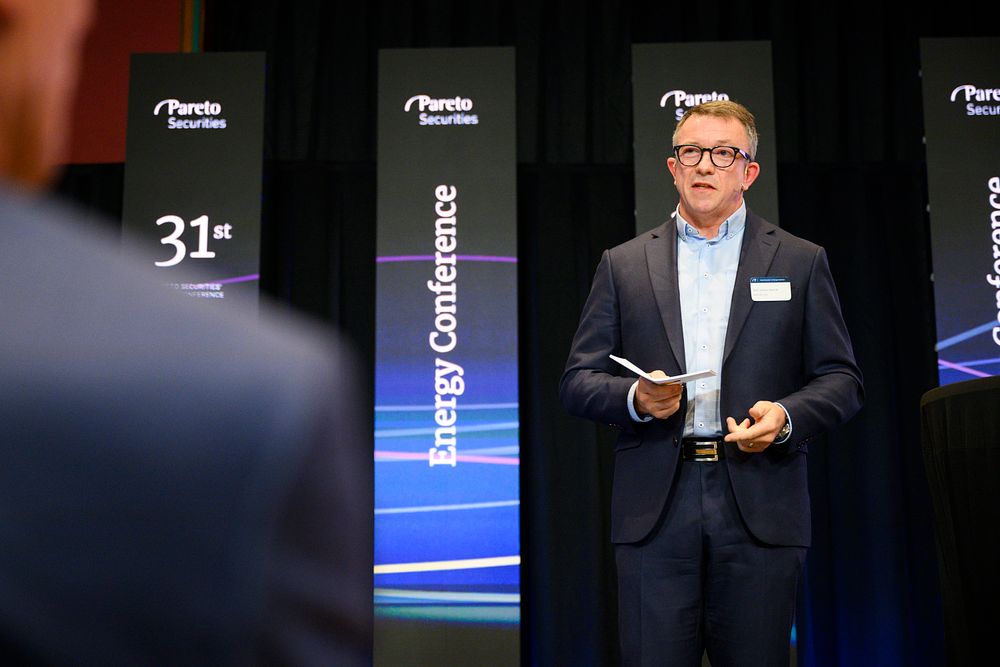
Aker BP's chief Karl Johnny Hersvik met the press on Monday morning at the oil and energy exhibition ONS in Stavanger, with the phrase "The Rebel Revolution" displayed on a TV screen behind him. He mentioned that the word signifies his belief in a "revolution in productivity", meaning that more can be achieved with fewer resources.
Hersvik expects future Norwegian seabed production to belong to those who can produce more with less resources, faster, simpler, and at lower costs. He highlighted the Kjøttkake project, which is expected to enter production very soon. Large oil and gas companies have advocated for a new era in the seabed, anticipating fewer large, independent developments and more smaller field developments.
Many of the simple wells have already been found and produced, says Hersvik, and he believes projects will become more complex in the future, involving higher temperatures, pressures, and other types of reservoirs. The dominant oil and gas producer in Norway plans to increase production to over 500,000 barrels of oil equivalent per day by 2030.
Currently, production is expected to be between 380,000 and 400,000 barrels per day. Hersvik believes it is possible to extract more resources from the Norwegian seabed. He expressed optimism, even calling himself "superoptimistic", but warned that it won't be easy. He disagreed with the notion that this will be a "sunshine story".
Aker BP's chief agrees with the Seabed Directorate that more drilling is needed in the seabed, but believes that production may not drop as rapidly in the 2030s and 2040s as the Directorate's possibilities suggest. He envisions a curve that holds much longer, potentially flatting out and staying relatively flat around 2040. He believes that with a 10- or even 15-year perspective, you need to consider the Norwegian seabed.
Aker BP and its partners are now in the midst of several gigaprojects, including Yggdrasil, Valhall PWP-Fenris and phase three of Johan Sverdrup. The oil price of around 90 dollars per barrel must be maintained for these investments to pay off within a year, Aker BP's chief recently stated. He illustrated this with a video of large constructions being towed out to sea.
For him, this is extraordinary and a bit tough, he said. He praised the suppliers who are now ready to complete several of the large platform projects. Aker BP has used 130,000 tons of steel in recent years for the platforms alone, equivalent to 25 Eiffel Towers, Hersvik explained, showing models of the Eiffel Tower on a table. The oil and gas industry has seen high activity since the 2020 crisis, but many believe the seabed is in a turning point.
Last month at the last ONS exhibition, Hersvik warned about a possible brake in the supplier industry if no measures are taken. The Labour Party has called for new stimulus packages for the industry, while the government has repeatedly refused new rescue measures. Earlier this year, Hersvik told E24 that the industry itself must take responsibility for its own fate.
He emphasized that there will be fewer new, large projects in the future and that parts of the supplier industry will have less to do. However, he did not call for new government support packages to boost activity. On Monday, Aker BP's chief's proposal for a public debate on the validity of the government's permit for the development of Aker BP-operated Yggdrasil and two other fields is scheduled to begin.
Greenpeace and Nature and Youth argue that the climate effects were not adequately assessed and won in the district and county courts. The government has changed its practice regarding seabed development plans and now requires stress testing of the profitability of fields under different climate scenarios. Norwegian oil and gas companies like Aker BP and Equinor are betting on keeping production going well beyond 2030.
They often face criticism from parties and activists who want a different direction and are worried about emissions. The outlook for global fossil fuel demand is very uncertain, according to estimates from the International Energy Agency (IEA) in 2024: the Seabed Directorate's various scenarios for production in the Norwegian seabed up to 2050 are consistent with the Paris Agreement's climate goals, and show a public review.
Written by urgent.news from E24 Norway's reporting — not their text. Machine-written — may contain errors; check the original before relying on it.