A rural city, once known for livestock, now provides China’s AI computing fuel
For generations, Ulanqab – a city several hundred kilometres northwest of Beijing whose Mongolian name means “red cliff pass” – was known for its windswept pastureland, where cattle grazed and potatoes thrived under long hours of sunlight. Its economy hinged on the weather, driven by the cool, strong breezes sweeping through the Yinshan mountain range. Today, giant wind turbines stand next to…
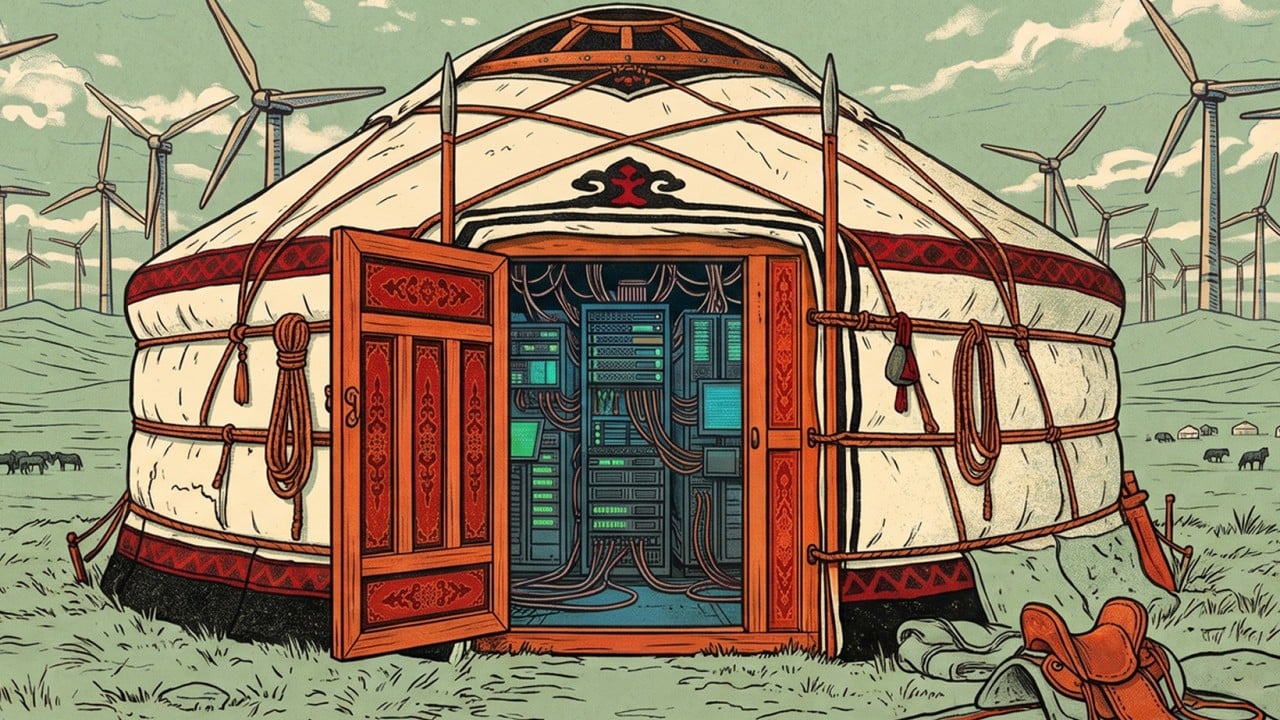
Ulanqab, a city in Inner Mongolia, China, once renowned for its pastoral landscape and livestock, is now turning into a crucial hub for China's artificial intelligence (AI) industry. This transformation is driven by the region's abundant wind resources and a decade-long shift from traditional agriculture to AI-focused data centers.
The renewable energy company Envision Group recently inaugurated the Galaxy Campus in Ulanqab, a massive AI computing facility featuring a 120,000-square-meter data center capable of accommodating up to one million AI accelerators. With a planned power capacity of over two gigawatts, it is set to become one of the world's largest AI computing centers.
Ulanqab's suitability for AI computing lies in its unique climate and geography. It holds about one-tenth of China's total wind resources and one-third of Inner Mongolia's, providing a renewable energy source that can be harnessed for computing purposes. The climate also allows for natural cooling, reducing the need for energy-intensive cooling systems.
Over the past decade, several major tech companies have established data centers in Ulanqab, including Huawei, Apple, UCloud, Kuaishou, VNET, Centrin Data, Chindata, and DeepSeek. As of June, the city had secured 89 data center deals, with 86 of them being AI computing projects. Ulanqab currently boasts a combined 12.5 gigawatts of capacity under development or planned, surpassing Malaysia's Johor state, which has become another major data center hub in the region.
The shift to AI computing is not without its challenges, however. Each AI token generated requires significant electricity, with estimates suggesting that one million tokens consume between two to three kilowatt-hours of power. In Ulanqab, data center operators benefit from some of China's cheapest electricity rates, with some operators paying as little as 0.35 yuan (US$0.05) per kilowatt-hour. This can lead to substantial cost savings, with annual power bills potentially reduced by hundreds of millions of yuan.
Despite the advantages, the AI industry in China is still working on ways to monetize its models. However, the availability of cheap power is proving to be a crucial factor in the business model. Coupled with the city's cold, dry climate that enables natural cooling, Ulanqab is well-positioned to become a leading player in China's burgeoning AI industry.
Written by urgent.news from SCMP Tech's reporting — not their text. Machine-written — may contain errors; check the original before relying on it.
This story
This is one outlet's version. Read the fullest account.