A rural city, once known for livestock, now provides China’s AI computing fuel
For generations, Ulanqab – a city several hundred kilometres northwest of Beijing whose Mongolian name means “red cliff pass” – was known for its windswept pastureland, where cattle grazed and potatoes thrived under long hours of sunlight. Its economy hinged on the weather, driven by the cool, strong breezes sweeping through the Yinshan mountain range. Today, giant wind turbines stand next to…
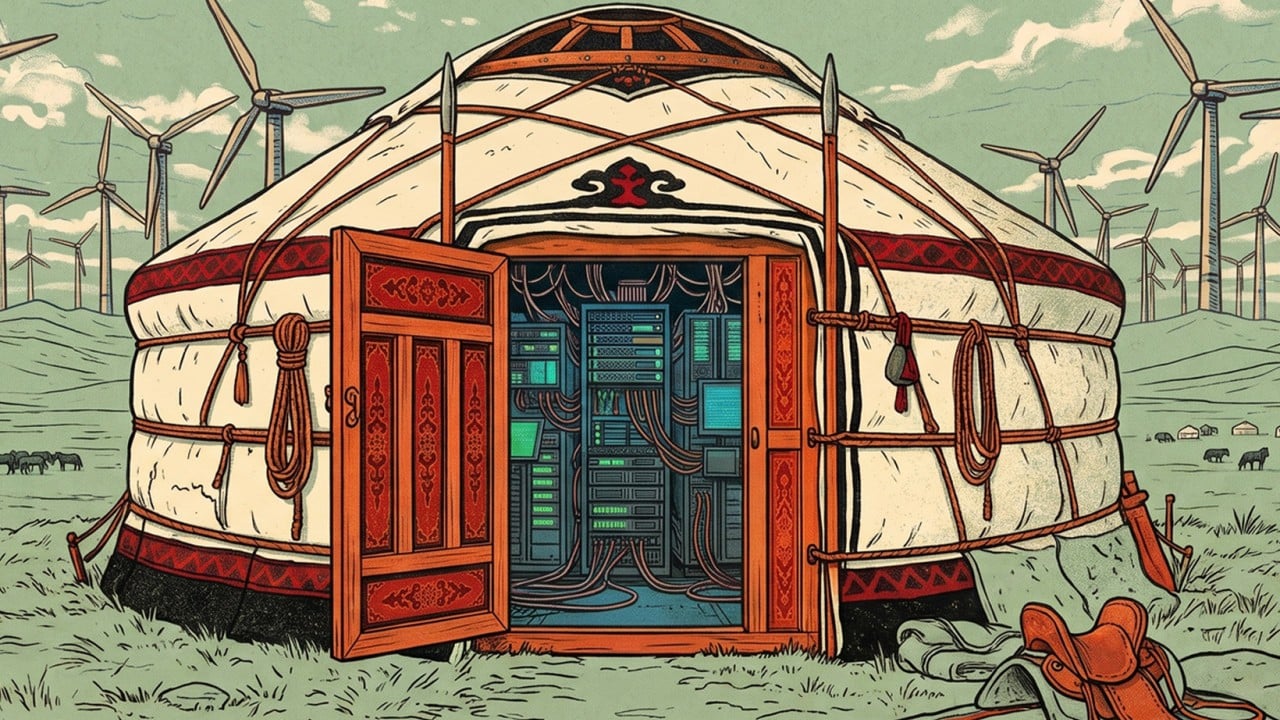
Ulanqab, a city in Inner Mongolia, China, has transformed from a region known for its pastoral economy into a major player in China's artificial intelligence (AI) sector. Previously, the city's economy relied on the fertile grasslands and cool breezes from the Yinshan mountains, which sustained cattle grazing and potato farming. However, with the global AI boom, Ulanqab has become one of China's most coveted assets for AI computing.
To cater to this growing demand, Envision Group, a Chinese renewable energy company, opened its Galaxy Campus AI computing facility in Ulanqab earlier this month. The facility comprises a massive 120,000-square-meter data center, capable of accommodating up to one million AI accelerators and boasting a planned power capacity of over two gigawatts. This makes it one of the world's largest AI computing facilities.
Ulanqab's strategic location is ideal for AI computing due to its proximity to China's largest wind resources, accounting for about one-tenth of the country's total wind resources and one-third of the Inner Mongolia autonomous region's. Envision Group selected Ulanqab as the location for the Galaxy Campus because it could directly pair computing infrastructure with renewable power.
A significant portion of Ulanqab's energy, including solar power, is already powered by green electricity, with about 67% of the city's energy being renewable.
The shift to AI computing in Ulanqab has been a gradual process. In 2013, Huawei Technologies began expanding its data center presence in the city, followed by Apple's plans to host its iCloud service in Ulanqab five years later. Chinese cloud platform UCloud also built a facility in Ulanqab in the same year. Short video giant Kuaishou initiated construction of a data center in 2020, and other traditional data center operators have since added green, AI-focused computing projects in the city.
As of June, Ulanqab had signed 89 data center deals, with 86 of them being AI computing projects. The city has a combined capacity of 12.5 gigawatts under development or planned, three times the 4.2 gigawatts projected for Johor, Malaysia, which has emerged as one of the largest data center sites in the Asia-Pacific region.
The shift to AI computing in Ulanqab has also brought about a change in how the city measures its power economy. Every one million AI tokens generated requires two to three kilowatt-hours of electricity, with power costs accounting for 60 to 70% of a data center's operating expenses. Cheap power is a significant advantage for Ulanqab's data center operators, as electricity can significantly reduce the cost of running a one-gigawatt AI computing center by up to 876 million yuan per year.
Written by urgent.news from SCMP Business's reporting — not their text. Machine-written — may contain errors; check the original before relying on it.