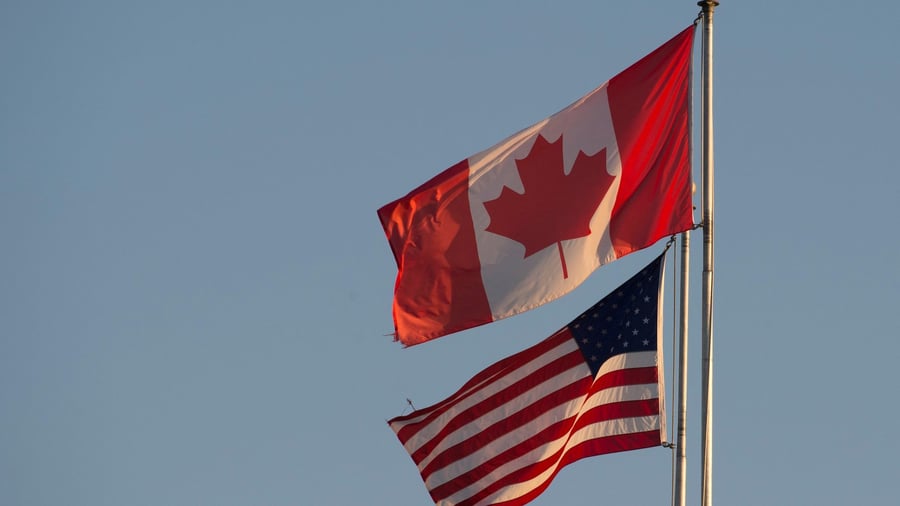
Zollstreit eskaliert: Streit zwischen USA und Kanada schürt Sorge vor Handelskrieg
Kanada reagiert auf US-Zölle mit Gegenmaßnahmen. In beiden Ländern warnen nicht nur Wirtschaftsverbände vor höheren Kosten und fordern eine Rückkehr an den Verhandlungstisch. Doch Trump legt nach.
The US and Canada's escalating trade dispute has raised concerns about the potential for a trade war. Business associations in both countries warn of severe economic consequences and urge a return to negotiations. However, statements from the US government offer little hope for a swift resolution. Higher tariffs could raise costs for US businesses and consumers, disrupt vital supply chains, and strain economic relations between the two nations, warned Joshua Bolten, chairman of the US Business Roundtable, representing CEOs of about 200 major corporations.
Both governments should return to the negotiating table and eliminate harmful tariffs, he called for. Canada's industry association head, Dennis Darby, echoed this sentiment, stating that their wish is for a quick return to negotiations, though he doubts it will happen soon. The ongoing uncertainty about companies' investment readiness could undermine their confidence in investment decisions, he noted.
After talks failed, tariffs of up to 50 percent were imposed on a range of Canadian goods, affecting about $20 billion worth of imports, including hockey sticks, furniture, honey, and wine. Canada's Prime Minister Mark Carney announced retaliatory measures to take effect in September after the talks collapsed. Asked why he perceived a trade war, Carney said, "When you are attacked, you are at war - we were attacked."
US President Donald Trump criticized Canada on social media, accusing it of treating the US like a state without being one, and vowed to end the unfair burden of tariffs on Canadian farmers. "Enough is enough!" he wrote. "Costly and harmful spirals" Verghese Fontaine, director of the Center for a New American Security, warned that a tit-for-tat escalation could trap both sides in an expensive and damaging cycle of countermeasures.
The Canadian government has drawn the conclusion that yielding to the Trump administration would only prompt further demands, he wrote. "They have arrived at the conclusion that caving to the Trump regime would only bring more demands," he added. Europe was cited as a negative example, with Trump's advisor suggesting it as proof that confrontation does not yield favorable results.
Democratic leaders in Canada's largest province, Ontario, welcomed Carney's refusal to accept the "bad agreement" with the US. Industry representatives had rejected the US offer, according to Premier Doug Ford. Danielle Smith, Premier of Alberta, the province bordering Canada, expressed support for stepping away from negotiations but was cautious about Carney's plan for retaliatory tariffs on US goods.
Kathy Hochul, Governor of New York, which borders Canada, called the trade dispute unnecessary and warned of rising prices for US consumers. The implications of a trade war could also affect the upcoming midterm elections in November, with Trump's Republican party facing pressure due to rising prices resulting from the ongoing US-Iran conflict and the complex Hormuz Strait situation.
Written by urgent.news from Handelsblatt's reporting — not their text. Machine-written — may contain errors; check the original before relying on it.