AI for studying: Expert explains how students can use it to learn, not just get answers
<p>Doha, Qatar: Artificial intelligence can help teachers save time and give students a more personalised learning experience, but it should remain an assistant rather than replace teachers or students' own thinking, Fatma Al-Shurouqi, a master's researcher in STEM education and technical and vocational education and training at the University of Doha for Science and Technology (UDST), and an AI…
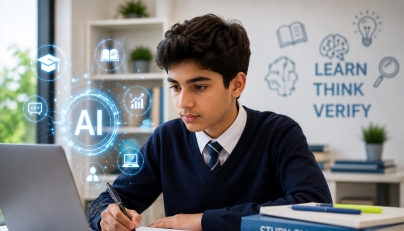
Doha, Qatar - Artificial intelligence (AI) can be a valuable tool for educators and students, enhancing the learning experience without replacing human involvement, according to Fatma Al-Shurouqi, a STEM education researcher at the University of Doha for Science and Technology (UDST) and AI trainer. Al-Shurouqi cautioned that AI should assist, not replace, teachers or students' own thinking.
She emphasized that AI encompasses tools to help teachers prepare lesson plans, simplify information, generate ideas, provide feedback, and tailor learning to students' varying needs and abilities. AI is a smart assistant to teachers, not a replacement for them. Teachers possess the capacity to understand individual student needs, motivate them, and build human relationships.
One of AI's most useful applications, according to Al-Shurouqi, is assisting teachers who face heavy workloads. Teachers often handle different grades and classes with students of different levels and learning needs. Preparing separate activities for all these groups can be time-consuming. AI tools can help teachers create tailored activities, generate mind maps and presentations, simplify information, and provide feedback.
They can also analyze students' answers to identify areas of weakness and help develop remedial plans.
For students, AI offers the potential for personalized learning. Unlike a conventional classroom where a teacher must explain a concept multiple times within a short lesson, a student can use AI for additional explanations, simpler versions of material, or real-life examples. Students can even use AI interactively, asking it to generate questions, evaluate answers, and provide feedback.
This approach turns learning into a personalized and gradual process, as opposed to simply asking a question and receiving an immediate answer.
Al-Shurouqi advised teachers to focus on mastering a few AI platforms rather than trying to learn every available tool. Tools like Microsoft Copilot, Eduaide, and Gamma can be particularly useful for educational planning, presentations, and creating complete presentations within seconds. However, she cautioned about the risks associated with AI in education, including inaccurate information, blind trust in AI-generated responses, excessive dependence on technology, and academic cheating.
Rather than prohibiting AI use altogether, Al-Shurouqi argued that educators should teach students how to use it critically. She suggested asking students whether they have verified AI-generated information and checked its sources. Applying this approach to assignments would require students to compare information, verify AI-generated answers, identify sources, and connect it with their own experiences.
This shift would transform AI from a shortcut for completing assignments into material that students must evaluate and think about. The ultimate goal is to develop a sense of digital and intellectual responsibility among students as AI becomes increasingly embedded in education.
Written by urgent.news from The Peninsula Qatar's reporting — not their text. Machine-written — may contain errors; check the original before relying on it.