U.S. and Iran keep up hostile rhetoric ahead of new sanctions
As the war neared 6 months old, the two sides were not exchanging fire but also not pursuing peace talks.
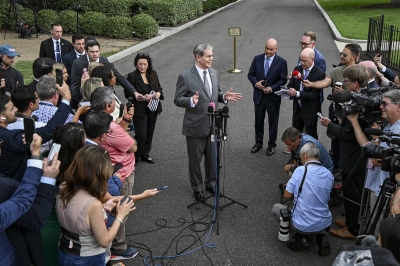
On Friday, Iran declared it would respond to any new U.S. threats with devastating consequences, following Washington's pledge to impose the harshest financial penalties in history aimed at toppling the Iranian leadership. Treasury Secretary Scott Bessent announced that he would reveal details on Monday about the proposed sanctions, which President Donald Trump vowed to enforce against any nation providing assistance to Iran.
Major General Ali Abdollahi, chief of staff for Iran's Armed Forces, stated that Iran's reaction would be broad and decisive, prepared for land, sea, air, air defense, and cyber warfare.
The ongoing conflict between the U.S. and Iran has resulted in thousands of casualties, drawn in other Gulf nations, and increased global fuel prices. Despite Iran's diminished economy and conventional forces, Tehran retains enough missile and drone capabilities to obstruct oil tanker traffic in the Strait of Hormuz and target regional adversaries.
Trump, who set objectives at the start of the war, including dismantling Iran's nuclear program, has yet to achieve those goals. Consequently, his approval ratings have plummeted to their lowest point in his current term.
Iranian Parliament Speaker Mohammad Baqer Qalibaf, the country's primary negotiator in mediated talks with the U.S., hinted that Washington may have acknowledged it could not succeed in a direct military confrontation. He emphasized the need to devise strategies to overcome unjust sanctions, stressing the importance of economic growth and national production. However, he acknowledged the strain on Iran's economy despite its military prowess.
International and U.S. crude oil futures surged on Friday following the U.S. threat of economic sanctions on Iran's trading partners, heightening concerns about potential supply restrictions. Bessent told CNBC that he would disclose the new sanctions details on Monday, adding, "We are going to collapse this regime." Iran has endured near-continuous sanctions for nearly 50 years since the Islamic Revolution of 1979, but its citizens face high inflation, a weakening currency, energy shortages, and damaged infrastructure.
Tighter sanctions could have broader implications globally, as China accounts for half of Iran's energy imports, with the nation buying more than 80% of Iran's exported oil. Despite China's eased restrictions on rare-earth mineral exports, the U.S. and China's continued economic warfare risks retaliation.
Written by urgent.news from Investing.com's reporting — not their text. Machine-written — may contain errors; check the original before relying on it.
This story
This is one outlet's version. Read the fullest account.
- Iran threatens military response to US sanctions nst.com.my
- US, Iran keep up hostile rhetoric ahead of new sanctions channelnewsasia.com
- US, Iran keep up hostile rhetoric ahead of new sanctions thejakartapost.com
- Iran threatens military response to US sanctions investing.com
- US sanctions 'declaration of war on all nations', Iran says middleeasteye.net
- US and Iran trade warnings ahead of new sanctions dailytimes.com.pk
- US, Iran keep up hostile rhetoric ahead of new sanctions al-monitor.com
- Iran warns of ‘devastating’ response to new US threats as oil prices rise on sanctions plan arabianbusiness.com