Urgent.News

What's breaking now, across thousands of outlets.

Business

Steigende Pegelstände: Rhein-Fähren können wieder fahren

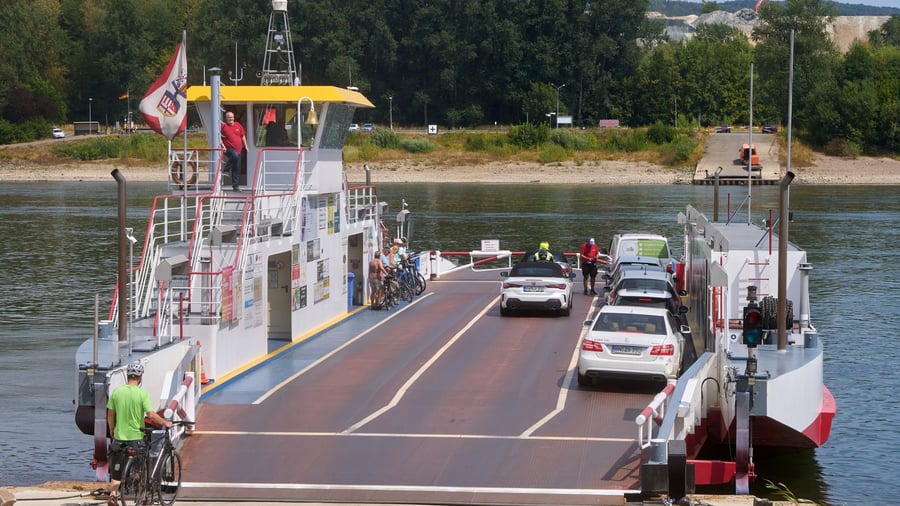
Der sonnige Sommer hätte die Geschäfte von Rhein-Fähren ankurbeln können, doch das Gegenteil war der Fall: Es war so wenig Wasser im Rhein, dass die Fähren nicht mehr fahren konnten. Bis jetzt.

Steigende Pegelstände: Rhein-Fähren können wieder fahren

After a week-long forced hiatus, an increasing number of Rhine ferries are resuming operation due to rising water levels. Jens Jansen, an operator of the ferry between Düsseldorf's south and Dormagen (Dormagen), told Deutsche Pressen-Agentur that the ferry could finally be back on the water today. "Since we earn most of our revenue in spring and summer, the economic consequences are considerable, naturally," he added.

The ferry is popular not only with car drivers but also with cyclists and pedestrians who make an excursion to Zons' historical old town from Düsseldorf, especially on weekends with good weather. However, this year, drought and extreme low water led to the forced pause. Jansen said it was "bitter, but that's nature." The company, which also employs his father and brother, had five full-time employees and five temporary workers.

"We were close to applying for short-time work." He was relieved that it was finally back in operation. The ferry of the Heimat- und Bürgervereins Bislich, which runs between Xanten and Wesel on the Lower Rhine, also planned to resume operation on Saturday after a three-week break. "That was our longest forced natural pause, during the low water in 2022 it was two weeks," said ferry captain Philipp Feine.

Only a gearbox damage required more time to get back on track. Water levels are still quite low. The ferry in Cologne started its operation again on Friday, the Siebengebirge ferry in Bad Honnef (North Rhine-Westphalia) and the ferry in Kaub (Rhineland-Palatinate) started again on the previous Thursday. "Things have relaxed, but who knows what will happen this summer," the Kaub ferry community said.

The ferry was out of service for eleven days. In Bad Honnef, there are still restrictions: due to the still quite low water level, no caravans or trailers are allowed, only cars up to the size of a VW bus are transported. The Rhine ferry between Bad Breisig and Bad Hönningen (Rhineland-Palatinate) restricted the maximum weight per vehicle to 7.5 tons, a special low-water ramp enabled the ferry operation to continue.

The Hitdorfer passenger ferry, which usually transported an average of 350 people per July between Leverkusen and Cologne or vice versa, should only resume operation as early as Monday, according to a spokeswoman for the city of Leverkusen. The forced pause since July has resulted in losses of about 30,000 euros. The water levels on the Rhine reached historical low points this month, falling into negative territory in Düsseldorf.

The Rhine is considerably deeper than the respective water level on the shore, in Düsseldorf it is 1.59 meters. In recent days, it went up significantly, in the NRW state capital a value of just under 40 centimeters was expected today. However, this is still a relatively low value.

Written by urgent.news from Handelsblatt's reporting — not their text. Machine-written — may contain errors; check the original before relying on it.

Read the original at handelsblatt.com →

More in Business

The man who dreamt up Century City

Martin Wragge, a South African property developer, is the enigmatic force behind some of Cape Town's most iconic developments, including Century City, Canal Walk Shopping Centre, and Ratanga Junction.

More from Saturday 22 August →