Dry Martian Meteorite Reveals Early Water in Mars's Crust
Billions of years ago, Mars was hypothesized to have been a habitable world with flowing liquid water and the potential for life. But directly studying its ancient past is currently limited to orbiters and rovers, as scientists have yet to obtain direct samples from Mars. However, meteorites have been found on Earth to have potentially originated from Mars during large impacts that flung chunks…
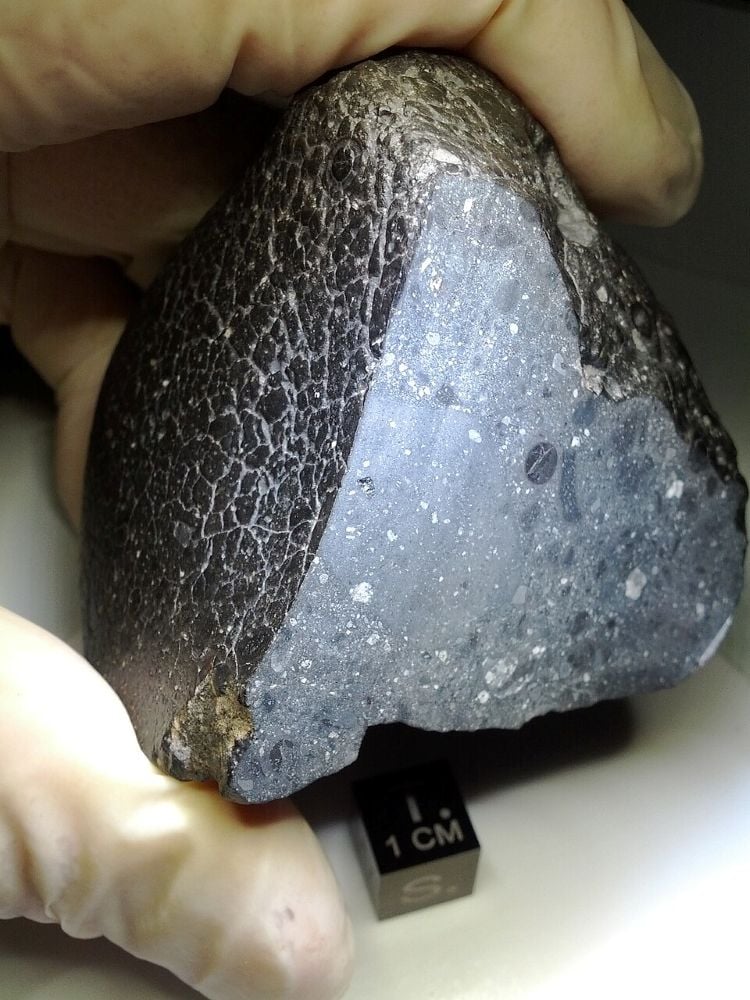
A Martian meteorite, dubbed "Black Beauty," may hold the key to understanding ancient water on the Red Planet, according to recent research. This meteorite, scientifically designated as Northwest Africa 7034 (NWA 7034) and estimated to be between 4.4 to 4.5 billion years old, is the only known meteorite from Mars' crust, blasted into space during a massive impact billions of years ago.
Utilizing advanced imaging techniques like X-ray and neutron tomography, an international team of scientists from Denmark and Switzerland has discovered evidence of hydrous materials in Black Beauty. These materials, which interact with water, were identified as tiny hydrated minerals and larger macroscopic hydrogen deposits through a combination of X-ray and neutron tomography.
Dr. David Mannes, a co-author of the study and scientist at the Paul Scherrer Institute, explained that neutrons are particularly sensitive to hydrogen, enabling the researchers to visualize these hydrogen deposits for the first time. The discovery of these water deposits in Black Beauty suggests that early Mars contained a substantial water reservoir, capable of interacting with its surface and crust to create crustal rocks that eventually formed Black Beauty.
These findings align with NASA's Perseverance rover's observations in Jezero Crater, where similar water-related materials were found. While Black Beauty sheds light on Mars' watery past, another notable Martian meteorite, Allan Hills 84001 (ALH84001), discovered in Antarctica in 1984, raised the possibility of ancient Martian life when it was initially identified as an asteroid.
Despite initial excitement, scientists later concluded that ALH84001's features could have formed through non-biological processes. Both Black Beauty and ALH84001 underscore the significance of obtaining Mars samples to enhance our understanding of the planet's history. Unfortunately, the planned NASA-ESA Mars Sample Return mission, which aimed to bring Martian samples to Earth, was canceled due to budget constraints.
As a result, researchers currently rely on meteorites like Black Beauty to unlock the mysteries of ancient Mars. Future missions, such as China's planned Tianwen-3, may eventually return Martian samples to Earth within the next decade, promising new insights into the "Black Beauty" meteorite and the early history of Mars.
Written by urgent.news from Universe Today's reporting — not their text. Machine-written — may contain errors; check the original before relying on it.