What happens when a galaxy's supermassive black hole turns off? These dying radio galaxies could show us
Astronomers have discovered a hitherto unseen population of galaxies with fading radio lobes, revealing what happens to these vast outflows when their black hole engines stall.
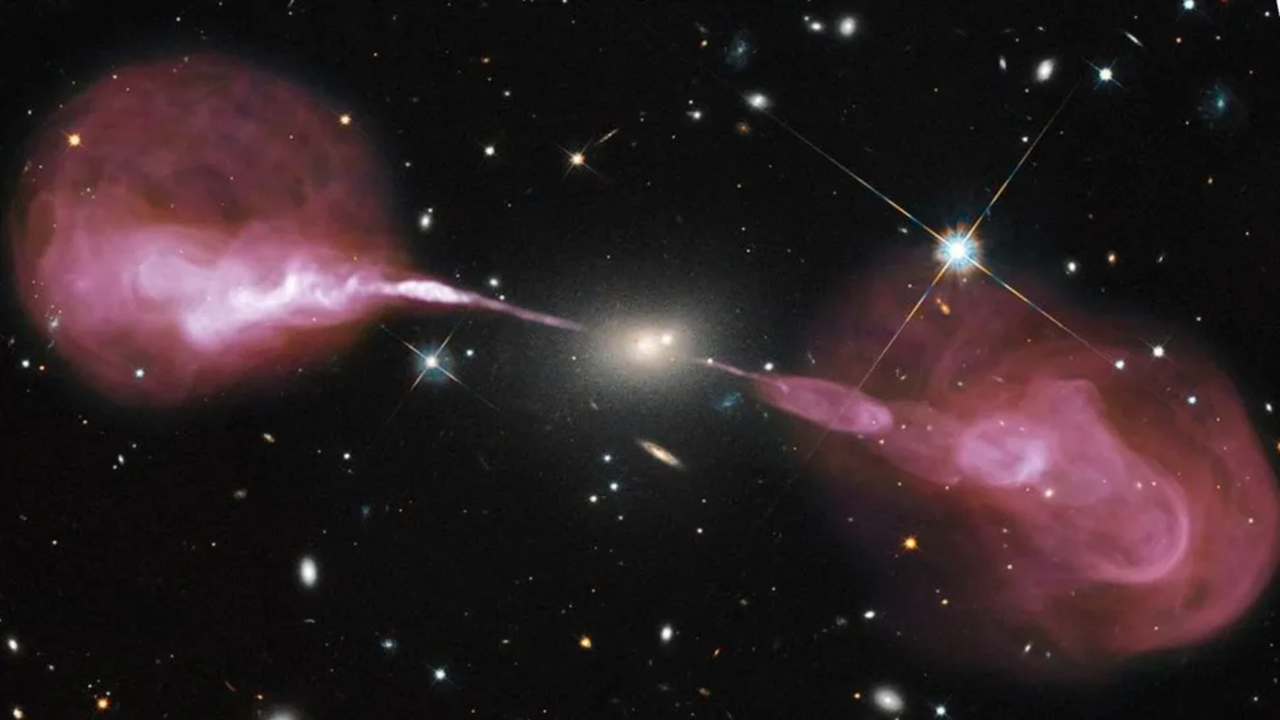
Scientists have identified a previously unknown group of galaxies known as radio galaxies showing fading radio lobes. This discovery sheds light on the life cycles of galaxies and the role of supermassive black holes. The team examined 14 candidates for faded or remnants of radio galaxies within a specific region of the sky, monitored by the XMM-Newton X-ray spacecraft called XMM–Newton Large-Scale Structure (XMM–LSS) field.
Radio galaxies emit strong radio waves and possess extensive lobes of gas stretching millions of light-years. When the jets emanating from a galaxy's central regions, or active galactic nuclei (AGNs) fueled by ingesting supermassive black holes, cease, the jets can no longer replenish the extensive radio lobes, leading to gradual fading.
The researchers employed the MeerKAT radio telescope, the Jansky Very Large Array, and the LOFAR network to analyze how radio emissions from the radio lobes of these galaxies evolve over time. From the 14 candidates studied, 12 were confirmed as remnants, while two remained active radio galaxies. The age of these remnants varied from 8 million to 42 million years, with an average fade age of 12 million years.
This age is younger than previously recorded for similar remnants, potentially indicating that astronomers have overlooked a population of short-lived remnants. Moreover, the research uncovered that these remnants exist in a diverse range of evolutionary stages, from recently quiescent to more evolved, having powered down long ago.
This study marks a significant advancement in understanding the life cycles of radio galaxies and the functioning of supermassive black holes as the driving force behind the jets that generate vast radio lobes. The findings were published on July 14 in the Monthly Notices of the Royal Astronomical Society.
Written by urgent.news from Space.com's reporting — not their text. Machine-written — may contain errors; check the original before relying on it.