Supreme Court Asks If Right To Work Can Become Fundamental Right Under Article 21
New Delhi, August 21, 2026: The Supreme Court has raised a larger constitutional question over whether the right to work should be treated on a par with the fundamental right to life and dignity under Article 21, while hearing a petition concerning minimum wages and delayed wage payments under rural employment guarantee schemes. A Bench of Chief Justice of India Surya Kant and Justices Joymalya…
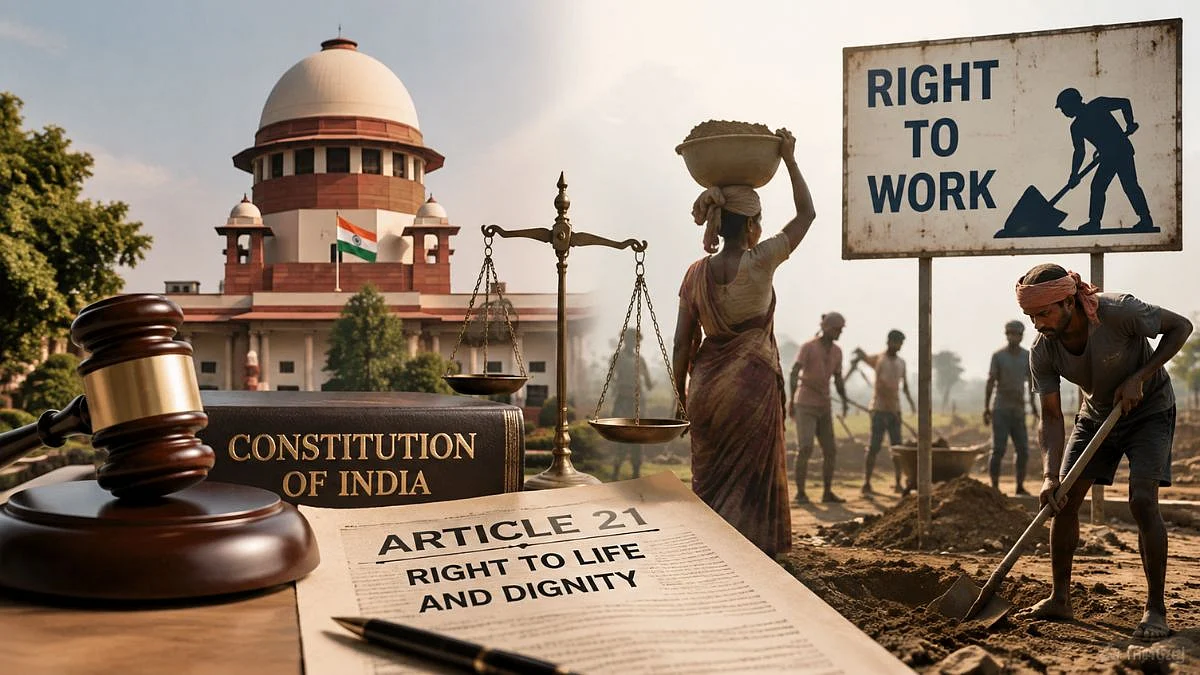
New Delhi, August 21, 2026: The Supreme Court's hearing of a petition related to minimum wages and delayed wage payments under rural employment guarantee schemes has taken on a larger constitutional significance. A Bench of Chief Justice Surya Kant and Justices Joymalya Bagchi and V Mohana questioned whether the right to work could be considered a fundamental right under Article 21.
"Is there a right to work that can be treated on par with the fundamental right to life and dignity under Article 21?" Justice Bagchi asked, highlighting the constitutional position that the right to work is not recognized as a fundamental right, but rather as a state obligation under the Directive Principles of State Policy.
The debate centers on whether treating the right to work as an enforceable fundamental right would significantly expand the state's constitutional obligations, particularly as employment guarantee programs depend on policy choices and available resources. Justice Bagchi also raised the question of potential consequences if the state were to reduce its social welfare activities.
The Court is also considering a minimum wage issue, with petitioners arguing that workers under the rural employment guarantee scheme should receive wages on par with the minimum wages notified by the respective states. The new law, the Viksit Bharat-Guarantee for Rozgar and Ajeevika Mission (VB-G RAM G) Act, came into effect from July 1, 2026, guaranteeing up to 125 days of employment per rural household and ensuring that wage rates cannot be lower than those under the previous MGNREGA.
Written by urgent.news from Free Press Journal's reporting — not their text. Machine-written — may contain errors; check the original before relying on it.