Strange Signals Called Long-period Radio Transits Come From Cataclysmic Variables
Long-period Radio Transients are sources that emit repeating radio and x-ray signals. The signals are polarized and coherent, and are similar to pulsars in some respects. But the type of astrophysical object responsible for them has been vigorously debated. New research says that at least one of them comes from a cataclysmic variable, a binary star where a white dwarf and a red dwarf orbit…
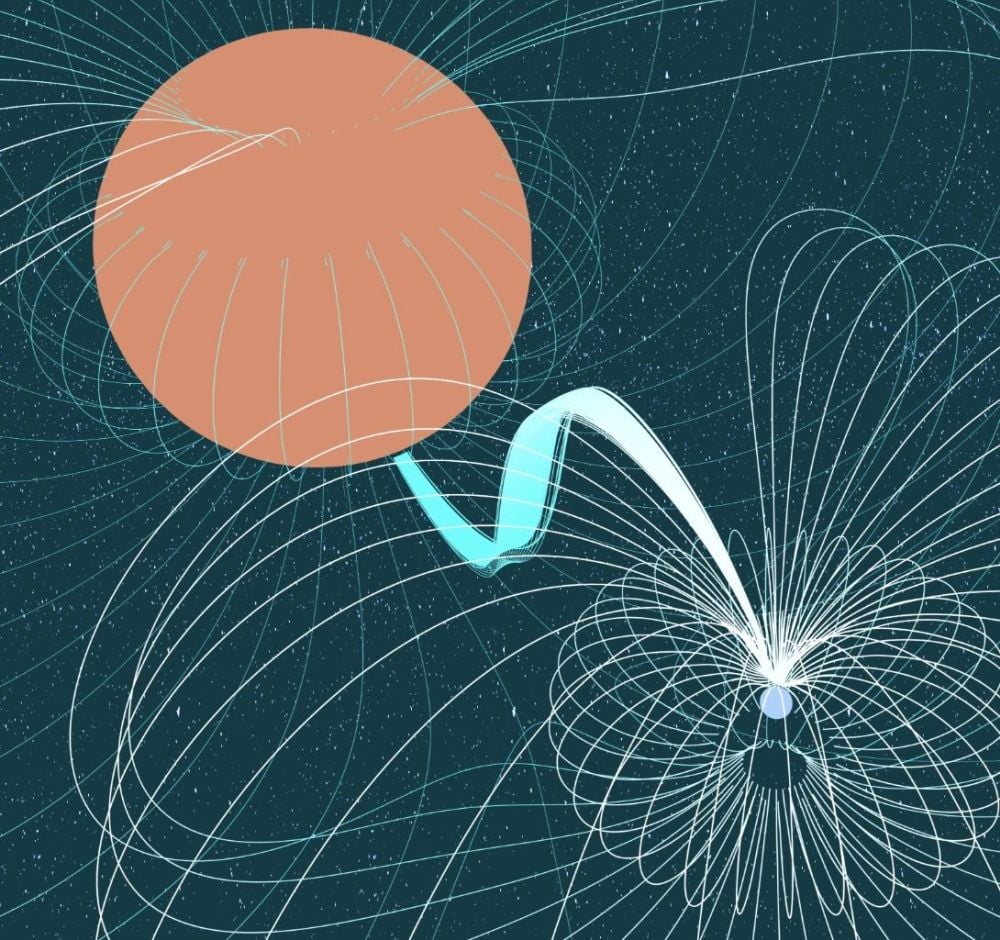
Strange radio signals known as Long-period Radio Transients (LPTs) originate from objects within our galaxy and consist of highly polarized, coherent radio bursts that repeat at regular intervals, ranging from a few minutes to a few hours. Scientists first detected hints of LPTs in 2005, but their origins have remained a mystery.
A new study titled "Periodic radio and X-ray emission from an accreting white dwarf binary" published in Nature Astronomy provides an explanation for at least one type of LPT. Lead author Kovi Rose from the University of Sydney's School of Physics and CSIRO, along with co-author David Kaplan from the University of Wisconsin Milwaukee, presents the discovery and explanation of a new LPT named LPT ASKAP J174508.9-505149, referred to as J17 in the article.
J17 exhibits a 1.3-hour orbit and displays orbitally modulated X-ray emission and radio bursts. The radio bursts are elliptically polarized and drift in emission frequency, potentially due to a longer beat period. Interestingly, the radio signal switches off for several hours at a time, providing a clue to the mechanism behind the LPT.
The signal also exhibits pulse properties not previously observed in LPTs, offering valuable insights into the progenitor system. The researchers speculate that J17's source is a "cataclysmic variable," a binary star system where one star is a highly magnetized white dwarf and the other is a donor star.
White dwarfs actively pulling material from companion stars are responsible for Type 1a supernova explosions, but in cataclysmic variables, the process differs. While LPTs may resemble pulsars, they are distinct. The pulsing observed in LPTs is not due to a spin but rather an orbit. In the case of J17, a white dwarf about the size of Earth with a mass similar to the Sun orbits a red dwarf with roughly one-tenth of the Sun's mass.
They are extremely close, completing an orbit in just over an hour, and the donor star's material may occasionally spill onto the white dwarf, generating the specific signatures observed in LPTs.
Written by urgent.news from Universe Today's reporting — not their text. Machine-written — may contain errors; check the original before relying on it.