Starlink would help the least served in rural India, says Elon Musk
Elon Musk, the founder of SpaceX, has highlighted the potential of Starlink's satellite internet service to bridge the digital divide in rural India. In a post on social media, Musk emphasized that Starlink would benefit the least served in India, especially those residing in rural areas. This statement came in response to a post from a DogeDesigner X account, which advocated for the introduction of Starlink services in remote Indian villages.
India currently faces a significant connectivity gap between its rural and urban regions. As of May 2026, 11,256 listed villages lacked 4G coverage. Out of India's 1.093 billion internet subscriptions, 440.87 million were found in rural areas, resulting in a subscription density of 48.31 per 100 people compared to 126.80 in urban areas.
SpaceX has recently submitted a new application to the Indian National Space Promotion and Authorisation Centre (IN-SPACe) to obtain approval for its second-generation (Gen 2) satellite constellation. This system boasts enhanced capabilities, including direct-to-device connectivity. However, Starlink's entry into the Indian market has previously encountered security-related obstacles, with the Ministry of Home Affairs placing a hold on approval in June due to security concerns.
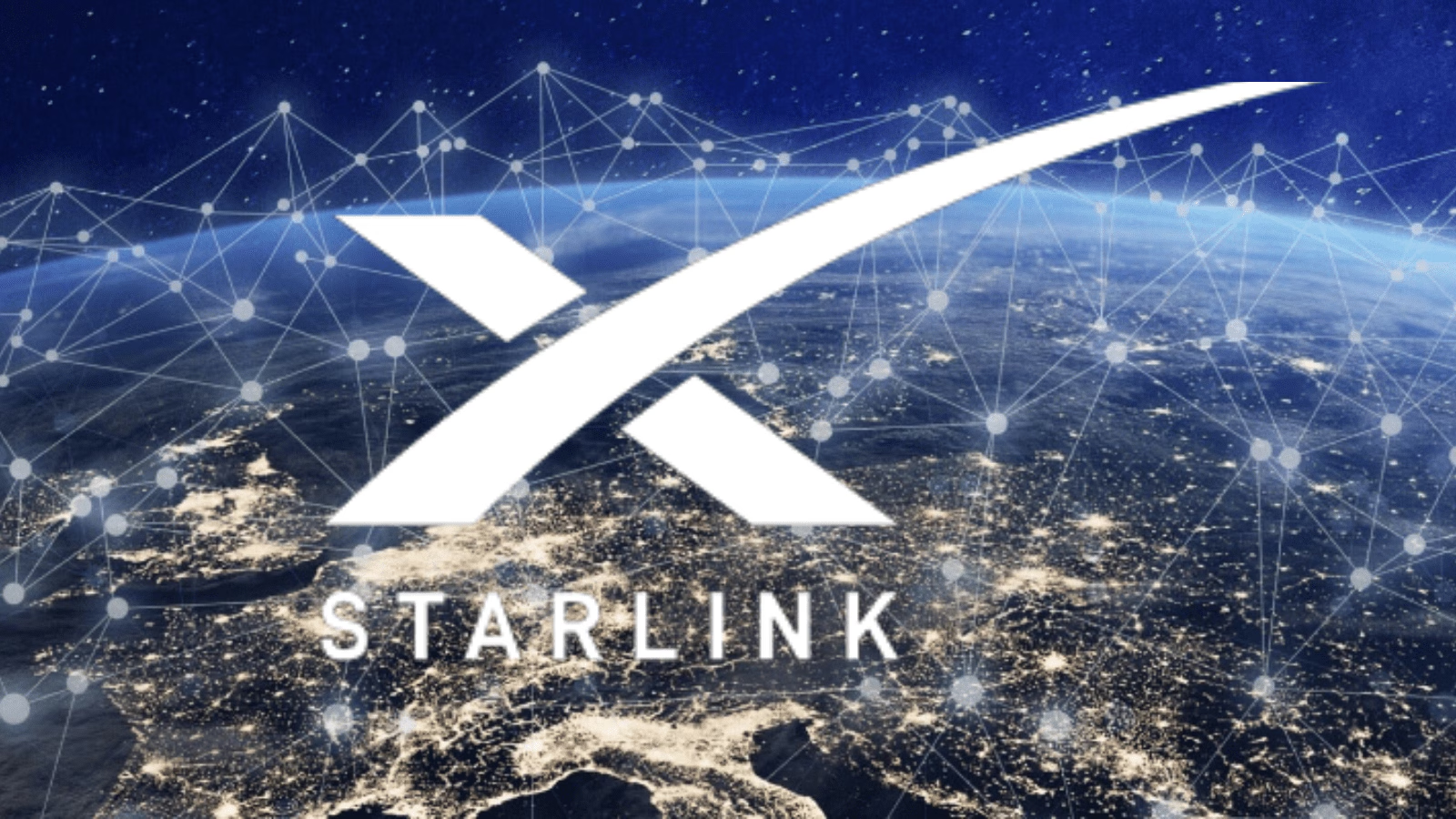
Starlink operates a network of low Earth orbit (LEO) satellites, which orbit much closer to Earth than traditional geostationary satellites. This proximity reduces latency and enables the service to provide internet connectivity without depending on conventional cellular towers. In rural India, Starlink could prove invaluable, particularly in remote areas where laying down fibre networks or deploying numerous mobile towers is impractical or costly.
The service demands a customer terminal instead of extensive ground infrastructure, potentially enabling it to reach communities that remain underserved.
While Starlink is not intended to wholly replace existing mobile networks, its capacity is most suitable for areas with low population density. Elon Musk has previously stated that the service may only serve a limited number of users in densely populated urban areas, where conventional cellular networks can support a far greater number of individuals.
Currently, Starlink has not launched commercial services in India, as it must first satisfy security conditions, acquire necessary spectrum assignment, and obtain other regulatory clearances. Other non-geostationary satellite operators have yet to commence commercial services in the country, and the Telecom Regulatory Authority of India (TRAI) has issued recommendations on satellite spectrum assignment and pricing, with subsequent recommendations and responses still under consideration by the Department of Telecommunications.
Telecom operators have also expressed concerns regarding competition from satellite internet providers, arguing that satellite operators offering direct consumer connectivity should be subject to comparable regulatory requirements.
Written by urgent.news from The Indian Express's reporting — not their text. Machine-written — may contain errors; check the original before relying on it.
This story
This is one outlet's version. Read the fullest account.
- 'Starlink Would Help The Least Served In India, Especially In Rural Areas': Elon Musk Backs Push For Commercial Approval freepressjournal.in
- 'Starlink would help the least served in India, especially in rural areas': Elon Musk timesofindia.indiatimes.com
- Starlink would help the least served in rural India, says Elon Musk indianexpress.com