Starcloud raises $250M to build AI data centers in orbit
Artificial intelligence hardware startup Starcloud Inc. today announced that it has raised $250 million in funding at a $2.3 billion valuation. Investment firm Manhattan West led the deal. It was joined by more than a dozen other backers including Nvidia Corp. and Cisco Investments. The cash infusion extends a Series A round that Starcloud announced in […] The post Starcloud raises $250M to build…
Artificial intelligence hardware startup Starcloud Inc. has raised $250 million in funding, bringing its total valuation to $2.3 billion. Investment firm Manhattan West led the deal, with contributions from over a dozen other backers including Nvidia Corp. and Cisco Investments. This is the company's third round of funding, following a $250 million Series A round announced in March.
Starcloud's latest funding comes just over a year after launching an Nvidia graphics card into orbit aboard a small satellite. The company successfully completed the first-ever orbital AI training run using the system. In the long term, Starcloud aims to launch 88,000 satellites with a combined computing capacity of 20 gigawatts.
Orbital AI clusters offer several advantages over terrestrial data centers, according to Starcloud. They don't require complex cooling systems and can generate power for onboard AI chips using solar panels. Unlike solar panels on Earth, which lose efficiency at nighttime, satellites can maintain constant solar power. Additionally, orbital solar panels can avoid adverse weather conditions like storms that block sunlight.
Starcloud plans to launch a follow-up system called Starcloud-2 in 2027, featuring onboard AI chips, storage equipment, and a data backup module. This system will be capable of running both training and inference workloads. Once data is collected by satellites, it can be analyzed in orbit and streamed to the ground faster than raw sensory datasets, saving time.
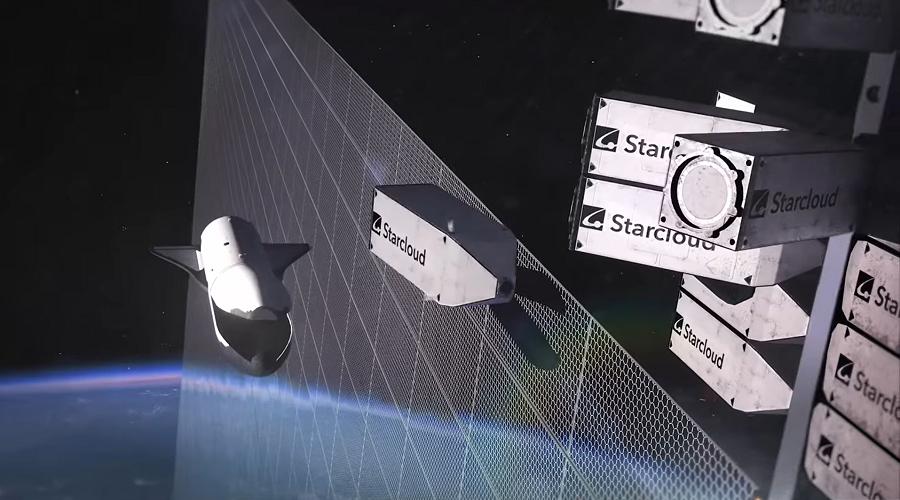
Following Starcloud-2, the company will develop two more satellite generations. The first, Starcloud-3, will include graphics cards, cooling equipment, and heat dissipation gear with a power footprint of 200 kilowatts. This is equivalent to the energy consumption of a few dozen homes. Starcloud's most advanced system, Starcloud-4, will be a cylindrical structure attached to a 2.5-square-mile solar array, equipped with numerous container-shaped data center modules designed to host liquid-cooled servers.
Written by urgent.news from SiliconANGLE's reporting — not their text. Machine-written — may contain errors; check the original before relying on it.