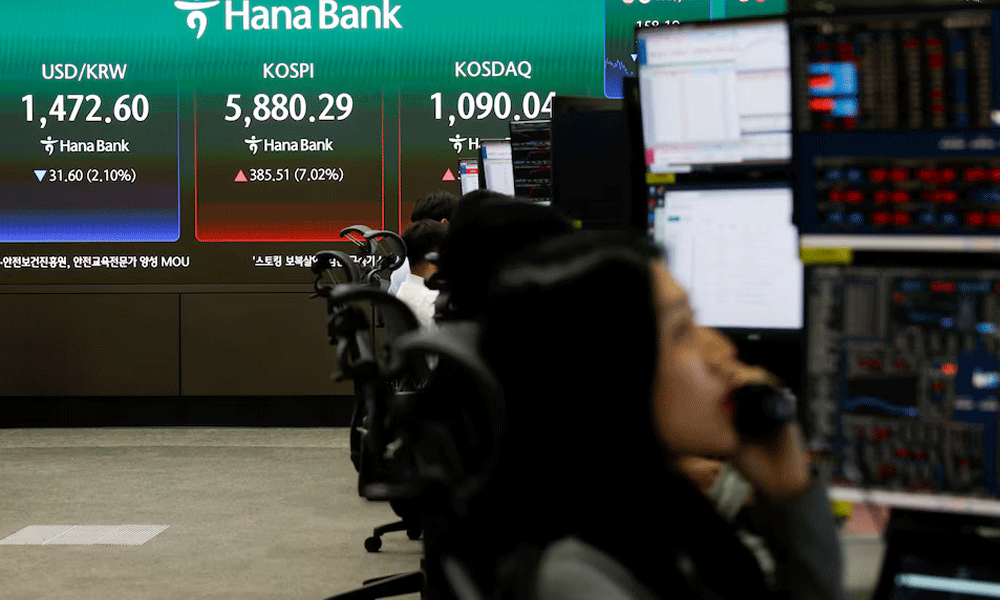
South Korea’s Shinhan partners with Solana Foundation, Etherfuse, Orca for tokenized fund issuance
The agreement covers a proof-of-concept for the issuance and distribution of a Korean won-denominated tokenized fund.

In early August, South Korea's exports continued their robust growth, providing additional support for the case to raise interest rates. According to customs office data released on August 21, exports adjusted for working-day differences increased by 61.5% from a year earlier in the first 20 days of August, marking a slight dip from the initially reported 62.9% rise in July.
On an unadjusted basis, shipments grew by 56%, while imports rose by 19%, resulting in a trade surplus of nearly US$14 billion (S$17.8 billion). Semiconductors led the gains, with exports soaring 198.8% from a year earlier. Shipments of computer-related products jumped 242.1%, while automobile exports declined by about 45%. These figures will provide a timely input for the Bank of Korea's (BOK) policy meeting next week, as economists remain divided on whether the next rate hike should occur in August or October.
The BOK already raised its benchmark interest rate by 25 basis points to 2.75% in July and has maintained a tightening bias. The data indicate that the export boom remains strong, driven by investments in artificial intelligence (AI) and data centers, which are fueling global demand for South Korea's memory chips and other technology products.
This strength has enabled the economy to absorb the impact of higher energy costs and uncertainty surrounding the Middle East conflict. The semiconductor boom has generated unusually large gains for the broader economy, with export prices surging about 49% in July from a year earlier, the highest since March 1998, and terms of trade improving by a record 24.7%.
The country's external position has also benefited from the export windfall, with the current account surplus reaching a record US$49.7 billion in June, as exports surpassed US$100 billion for the first time. Continued strength in exports would further reinforce the central bank's assessment that economic momentum remains robust enough to withstand higher borrowing costs, potentially leading to a back-to-back rate increase next week.
In July, policymakers largely agreed that further rate increases were necessary, with the timing and pace contingent on inflation, growth, and financial stability. Headline inflation slowed more than expected to 2.8% in July, but core inflation accelerated to 2.6%, indicating persistent price pressures. The economy expanded by a stronger-than-expected 0.6% in the second quarter from the previous three months.
Exports to China increased by 118.6%, while shipments to the US rose by 59.4%. Exports to Hong Kong and Vietnam jumped 245.5% and 67.4%, respectively.
Written by urgent.news from Straits Times Business's reporting — not their text. Machine-written — may contain errors; check the original before relying on it.
This story
This is one outlet's version. Read the fullest account.