Six-hour downpour sinks Gujrat, badly hits Narowal, Sialkot
GUJRAT: The city witnessed yet another worst urban flooding as six hours downpour submerged streets. Citizens were forced to remain indoors as commercial and routine activities were badly affected. According to the Water and Sanitation Agency of Gujrat, the city received 176mm rain between 3 to 9 am. Rural areas in city outskirts as well as Kharian and Sara-i-Alamgir too faced an adverse…
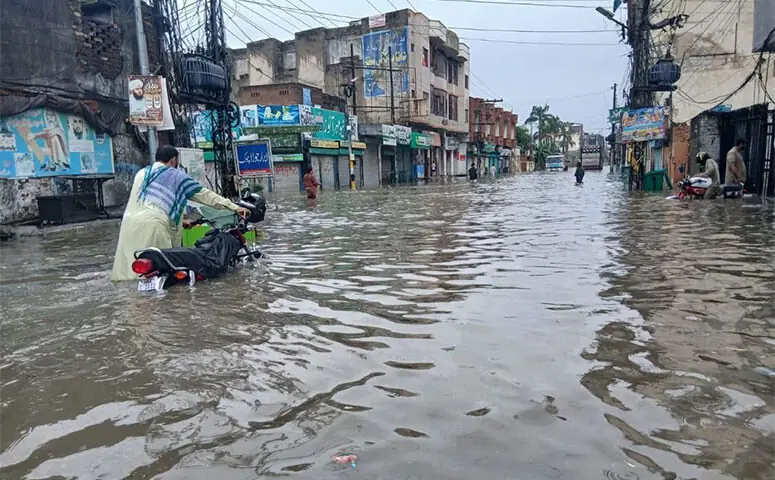
Gujrat city faced severe urban flooding over a six-hour period as heavy rain continued unabated. The torrential downpour of 176mm between 3 and 9 am submerged streets, forcing residents to remain indoors. Commercial and daily activities were significantly impacted. The Water and Sanitation Agency of Gujrat reported that rural areas, such as outskirts of Kharian and Sara-i-Alamgir, also suffered due to the extreme conditions.
The main GT Road linking Kharian and Lalamusa resembled a lake in several spots, particularly at Theekrian Morr and Panjan Kassana. The Loraiy Chowk in the outskirts remained inaccessible for hours as water flow was redirected into the Halsey storm water channel to prevent further damage. Key localities including Bhimbher Road, Rehman Shaheed Road, Jinnah Road, Ghareebpura Road, Court Road, Jail Road, Jalalpur Jattan Road, Circular Road, and their adjacent areas were heavily affected.
The District Courts Complex and district administration compound became inaccessible to the general public. Motorists were stranded in flooded streets, but rescue teams, including Rescue 122 staff and local volunteers, provided aid and clean drinking water. The Deputy Commissioner of Gujrat, Nurulain Qureshi, along with WASA Managing Director Kashan Hafeez Butt, visited various disposal stations and flooded regions.
Punjab Minister for Housing and Urban Development Bilal Yaseen and Secretary Housing Noorul Ameen Mengal also made their way to Gujrat. NAROWAL: The city bore the brunt of flash floods and heavy rains, leading to inundated agricultural land stretching across hundreds of acres. Rainwater infiltrated homes, shops, animal shelters, and communication roads sustained damage.
The swollen Bayn Drain, originating from occupied Kashmir, played a major role in causing widespread destruction in urban and rural areas. Consequently, the road connecting Norkot with Kot Naina was rendered impassable. NAROWAL: Narowal recorded 112mm of rain, with water levels rising to two to three feet in government offices, roads, and streets.
Two to three feet of water accumulation was also observed in Sialkot city, with rainfall figures ranging from 66mm to 178mm across different areas. LAHORE: Throughout the province, monsoon rains were reported in most districts, with Jhelum receiving 125mm, Attock 118mm, Mangla 105mm, Mandi Bahauddin 48mm, Murree 14mm, and Gujranwala 10mm.
The PDMA spokesperson disclosed that low-level flooding was observed at Head Marala on the Chenab River, while low-level flooding was also reported at Kalabagh, Chashma, and Taunsa on the Indus River. Presently, Tarbela Dam is at full capacity (100 percent), Mangla Dam at 71 percent, Aker Pong Dam at 54 percent, Thane Dam at 51 percent, whereas Bhakra Dam stands at 48 percent.
Written by urgent.news from Dawn - Pakistan's reporting — not their text. Machine-written — may contain errors; check the original before relying on it.